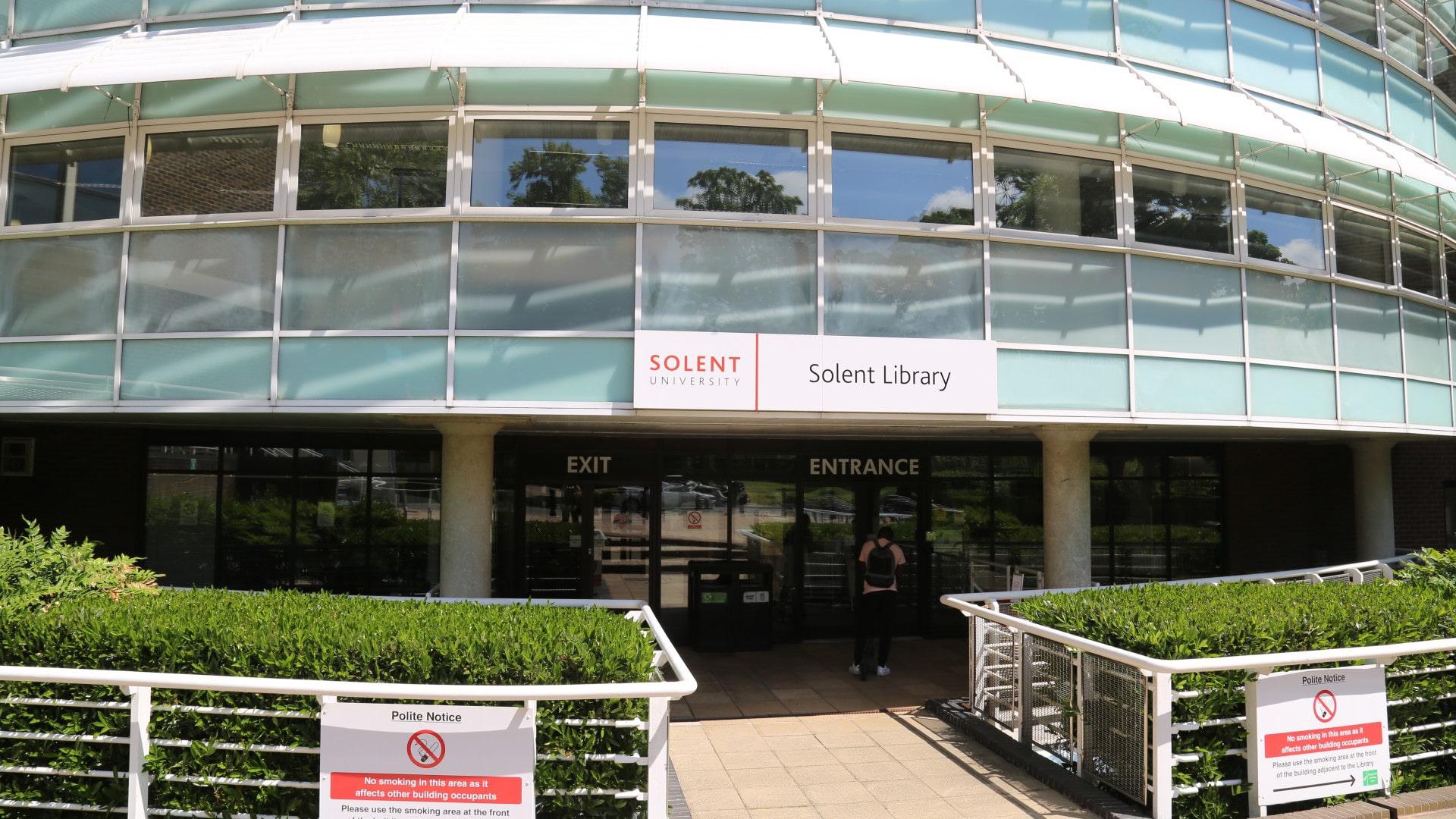
“Solent opened its SMART Centre during my course providing brilliant 3D printing facilities for engineers like me.”

Dylan Packham
Telecoms Satellite Payload Systems Degree Apprentice
Airbus, Defence and Space


Get ahead in an electronics career with this professionally accredited programme, combining practical challenges, excellent facilities and teaching from industry specialists and academic researchers.
Contact international admissions
Email: Call:With a broad curriculum covering everything from analogue and digital electronics to contemporary embedded systems, signal processing technologies and modern communications, graduates can expect to seek employment in research and development, maintenance engineering, electronic design, telecommunications and much more.
In the first year, students develop a solid foundation in maths and circuitry before getting to grips with analogue, digital and microcomputer systems. The latter half of the year is focused on developing an understanding of industry software, key professional skills and manufacturing techniques.
These proficiencies will form a solid foundation for the second and third year, where students will study embedded systems and advanced data communications, carry out their own research and undertake a major practical project.
If you’re looking to study our electronic engineering degree but don’t have the relevant qualifications or experience, the STEM foundation year will help you develop the core skills and knowledge to progress. Find out more about the STEM foundation year.
This course is also offered on a one-day-per-week part-time study basis for professional CPD, aimed at applicants already in employment. Applicants holding a relevant HNC qualification would normally be considered for entry on to year three of the six-year part-time course.
This course is part of the South Coast Institute of Technology (IoT), a partnership of colleges, universities and industry-leading employers to create new career opportunities in the technology sector. IoT courses like this one are precisely tailored to the needs of employers in the maritime, engineering and digital industries – industries which are hungry for talented new engineers, technologists, technicians and creatives like you.
Accredited by:
Part of:

Our creative degrees allow our students to develop a critical eye for design with a knowledge of different design approaches and problem solving techniques. Take a look at some of the great work they produce.

This course is perfect for electronics enthusiasts who wish to combine their knowledge with engineering skills to be able to pursue a career in areas such as electronic design, telecommunications, microcomputers or research and development.
This course can lead to a career in a range of electronic industries or further study. Graduate opportunities include a range of career paths in electronic design, microcomputer or embedded systems, possibly automation or circuit development.
Hear from Solent alumni about where their careers have taken them and how studying at Solent prepared them for their future.
Read more stories“Solent opened its SMART Centre during my course providing brilliant 3D printing facilities for engineers like me.”
Telecoms Satellite Payload Systems Degree Apprentice
Airbus, Defence and Space
The engineering team has a diverse range of academic and industrial experience and research interests in the fields of digital signal processing, micro-controller and embedded programming, the automation of sensing, capturing and processing data, and a range of electronic communication and simulation methods.
The University cannot guarantee any particular members of staff will teach specific aspects of the course in the future, but will endeavour to ensure the teaching team maintains their balance of experience and qualifications.
Electronic engineering students benefit from access to a range of high-end facilities including rapid prototyping equipment, PSpice/NI MultiSim software and microcomputer development systems. Solent University also offers students access to digital multi-meter signal generators, FLIR cameras and digital signal processing (DSP) boards – all of which allow students to better understand how the theory they have learnt links to real workplace scenarios.
Laboratories also include NI MultiSim eCAD software, rapid prototyping equipment with 3D printers and laser cutters, and a wide range of development systems for microcomputer and microcontroller systems.
Broaden your horizons by adding an international dimension to your CV – essential to achieving success in today’s fast-changing, global environment.
Studying, working or volunteering in another country could be the experience of a lifetime. Enhance your degree by developing important global skills such as knowledge of other countries, language skills, intercultural awareness, adaptability and confidence.
For more information, please email international.mobility@solent.ac.uk.

On this module you will learn how to apply a range of mathematical techniques to realistic engineering problems. You will use basic algebra and solve simultaneous equations and equations of straight lines to answer engineering problems around linked variables in mechanics and electronics.
This module is designed to introduce you to the electrical and electronic principles necessary to analyse circuit behaviour and design. It also provides the foundation for further study of more specialised electrical/electronic engineering techniques used later in your course.
This module sits within the circuit theme and is designed to give you an introduction to the basic terminology, concepts and devices used in electronic circuits.
This module helps you to develop an awareness of the factors affecting the selection of materials and processes used in manufacturing a product. It does this by comparing the attributes of materials and the suitability of processes in the light of the external factors that need to be considered when developing the product design specification.
Almost all modern engineering systems contain microcomputer systems, which are especially important in the development of industry 4.0. This module is designed to introduce you to this area and develop your knowledge of the theory and practice of structured programming through high-level language.
This module will introduce you to the profession of engineering. This includes both theoretical and professional skills relating to the role of the professional engineer and also supports your transition into higher education.
This module will equip you with the necessary mathematical knowledge and skill to critically evaluate and analyse electrical/electronic systems. It introduces key mathematical principles and methods, and examines circuit theory, in a way that reviews and extends the basic electrical and electronic principles that you will have encountered in FHEQ Level4.
In this module you will develop your understanding of the use of circuit theorems and principles. You will also see how such circuits can be used to meet a variety of electronic requirements for practical applications.
This module aims to familiarise you with the whole development cycle of embedded systems. Initially, you will consider the design and implementation of combinational and sequential logic systems.
This module is part of the communications theme and providing you with an introduction to the fundamental concepts of networking theory, which is an integral part of most engineering and industry 4.0 systems.
This module provides theoretical and practical foundations in automation and control engineering. You will develop a comprehensive understanding of underpinning mathematical techniques including Laplace transforms, Fourier transforms, control stability theorems, differential equations, control block diagrams, and Bode plots.
This module will introduce you to the business subjects of marketing, competition and law, including the nature of contracts and ethical considerations. These are key areas for any engineering business – as such every technically focussed engineer should have a good working knowledge of these areas.
You will develop knowledge of the theory and use of active filters, including basic filter types (Butterworth, Bessel and Chebyshev), filter topology, first-order, second-order and third-order filters, active low-pass, high-pass, band-pass and band-stop filter stages.
This module will consider the theoretical concepts and tools applicable to the analysis and design of discrete-time systems. This module discusses the concepts of sampling and the representation of discrete-time signals and systems.
The module provides a framework for understanding and evaluating the key design topics and choices in developing radio systems. The module is designed to complement the data communications part of the communications theme and to give the student a structured overview of the wireless communications with emphasis on link design, performance trade-offs, key limiting factors and practical issues in implementation over real world channels.
Carrying out project work is one of the most critical skills for your future career as an engineer. In this unit, you will carry out a project which is more significant in scale and complexity than previously. You will manage the project yourself.
Please note: Not all optional modules are guaranteed to run each year.
In this module you will study these organisational constraints by examining the role, techniques and difficulties involved in strategic business management, along with the processes and strictures of formal strategic planning.
This module will provide you with the opportunity to explore and develop your entrepreneurial talents, which are important if you want to develop your own business or understand how businesses are developed. You will develop knowledge and skills around the legal and human resource aspects of setting up and running a successful business.
Contact international admissions
Email: Call:As part of this course, you will study one module at a time, giving you the chance to build a deeper understanding and see the results of your hard work more quickly. With regular assessments and feedback, rather than exams all at once, you’ll also benefit from improved focus, and a more manageable workload.
Learn more about block teaching
The student achievement team are on hand to help you succeed during your studies at Solent. They aim to contact you at key times during your time here with personalised information, advice and guidance, by email or phone.
The disability advice team provides information, advice and guidance for disabled students.
All students can access Succeed@Solent, Solent's online guide to getting better grades. It offers extensive, practical information and advice on topics such as academic writing, research and presentations.
According to the Engineering Council, 18 per cent of the UK's workforce works in engineering. However, the sector is experiencing a skills shortage with a number of engineering occupations featuring in the Government's shortage occupations list. Electronic engineering is one of these occupations, meaning there should be many opportunities for industry-ready graduates to make their mark.
This course aims to provide students with the knowledge that electronic engineering employers will require. These range from essential mathematical concepts to circuitry, automation, data communications and signal processing skills. Critically, past students have been able to gain an insight into real-life engineering problems, tackling projects defined for them by our network of industry contacts.
Students are encouraged to interact with the industry throughout the curriculum. In previous years, Solent’s engineering students have had the opportunity to work closely with employers such as Rolls-Royce, SAAB, Sea Eye, TUV and Coopervision. The Institution of Engineering and Technology and the Wessex Round Table of Inventors (WRTI) have also held regular local professional development events on campus.

Starting salary: £25,000 to £33,000
Graduate training schemes may pay towards the top end of the starting scale. With experience, possibly working at an incorporated engineer level, you could earn around £30,000 to £45,000. As a senior engineer you can expect a salary in the range of £45,000 to over £65,000, with chartered engineers earning a salary at the top end of this scale.
Starting salary: £20,000 to £25,000
Mid-range salaries usually fall between £30,000 and £38,000. With experience, your salary could rise to £45,000.
The stated salaries are published on prospects.ac.uk. Income figures are intended as a guide only.
Hear from Solent alumni about where their careers have taken them and how studying at Solent prepared them for their future.
Read more stories“Solent opened its SMART Centre during my course providing brilliant 3D printing facilities for engineers like me.”
Telecoms Satellite Payload Systems Degree Apprentice
Airbus, Defence and Space
The Solent Careers team is committed to getting students into great careers.
While you are studying, the team can help you with finding work experience or placements, link you with a mentor, check your CV, or offer one-to-one guidance.
We also have graduate job opportunities just for Solent graduates.

6th
UK uni for sustained employment
Longitudinal Educational Outcomes, 2022
Our engineering degrees form part of the South Coast Institute of Technology (IoT), a partnership of colleges, universities and industry-leading employers to create new career opportunities in the technology sector. IoT courses like this one are precisely tailored to the needs of employers in the maritime, engineering and digital industries - industries which are hungry for talented new engineers, technologists, technicians and creatives like you.
Our engineering facilities are benefitting from a £8m investment to build a 2,000m2 state-of-the-art engineering centre - meaning students continue to have access to some of the most cutting-edge technologies to help support their studies while at Solent.

The tuition fees for the 2026/27 academic year are:
For further information, please visit our tuition fees page.
While most course costs are covered by your tuition fees, some essential resources and optional extras may need to be paid for separately. For advice on budgeting and managing your money, please contact student.funding@solent.ac.uk.
The 2026/27 additional costs are not yet available. For guidance, previous additional costs have been:
Optional costs
Solent University offers a range of bursaries and scholarships that provide financial assistance or waive fees for tuition or accommodation. Each bursary or scholarship has specific eligibility criteria. Check out our bursaries and scholarships pages to find out more.
Cost of living support
At Solent, we understand that the cost of living crisis may be of some concern. To help, we've put together some detailed information to show what support is available and how to make your money go further.
Graduation costs
There is no charge to attend graduation, but you will be required to pay for the rental of your academic gown (approximately £45 per graduate, depending on your award). You may also wish to purchase official photography packages, which range in price from £15 to £200+. Graduation is not compulsory, so if you prefer to have your award sent to you, there is no cost. Extra guest tickets will go on sale after results publication and will be sold on a first-come-first-served basis. The cost per ticket is currently £20. Please note, we do not guarantee there will be any extra tickets available to purchase.
Contact international admissions
Email: Call:Please select an option below:
As a general guide, we look for qualifications that are equivalent to the British high school A-levels.
If you are applying from outside the UK, find information about entry requirements, visas and agents for your country here.
For further information about EU qualifications, please see our course entry requirements document.
For international students who do not meet the direct entry requirements for this undergraduate degree, our trusted partner, QA Higher Education offers the following pathway programme designed to develop your academic and English language skills:
As a general guide, we look for qualifications that are equivalent to the British high school A-levels.
If you are applying from outside the UK, find information about entry requirements, visas and agents for your country here.
For further information about international qualifications, please see our course entry requirements document.
For international students who do not meet the direct entry requirements for this undergraduate degree, our trusted partner, QA Higher Education offers the following pathway programme designed to develop your academic and English language skills:
All international applicants need to be aware that the English language requirements to attend Solent University, and the English language requirements to obtain a visa from the Home Office, may be different. This means that if you meet the Solent University language requirement to gain a place on the course, you may still have to meet additional requirements to be granted with a visa by the Home Office.
We strongly advise all applicants to visit the Home Office website which outlines all the requirements for a successful visa application
Full-time
Any student applying for the first year of a full-time/sandwich undergraduate course must apply through UCAS (University and Colleges Admissions Service). This includes mature, overseas and EU students.
Nearly all schools and colleges offer their students the facility of applying electronically through the UCAS website using 'Apply'; it may also be used by those applying independently in the UK and overseas. This facility and all course information can be found on the UCAS website: www.ucas.com.
Your application should reach UCAS by 14 January if you hope to enter a course the following autumn. Early application is advised for the most popular subject areas. Late applications may be made until the end of June. The UCAS Code for the University is S30, code name SOLNT.
Find out what happens after you apply
Contextual offers
Solent endeavours to offer learning opportunities to students from all backgrounds. When we receive and review an application, we take into consideration the context and personal circumstances of applicants when making a decision, which means our advertised entry tariff could be reduced.
Find out more about Solent's contextual offers
Top-up route
We welcome applications from students currently studying a Foundation Degree, DipHE, HNC, HND or modules of an undergraduate degree course at another university, who wish to enter directly into Years 2 or 3 of one of our undergraduate degree courses. Please contact our admissions team for more information: contact us
Part-time route
Applications for part-time and distance learning courses are made directly to the University and can be made at any time prior to the start of the course. If you have any questions about applying for this course, please contact the admissions office by emailing admissions@solent.ac.uk.
Applicants who do not have English as their first language will be required to demonstrate an approved level of proficiency in the use of the English language. The agreed minimum requirements for this course are:
TOEFL IBT tests taken prior to 21 January 2026
TOEFL IBT tests taken from 21 January 2026
Qualifications are checked before enrolment, and international students must bring their original certificates or certified copies when coming to study at the University.
Pre-Sessional English programme
The University also offers a pre-sessional English programme for international students who wish to improve their level of English before starting a degree course.
Contact international admissions
Email: Call: