news
General
Erasmus Charter to expand international opportunities
Solent has awarded the Erasmus Charter for Higher Education, opening exciting opportunities for staff and students.
30 September 2026
8 June 2026
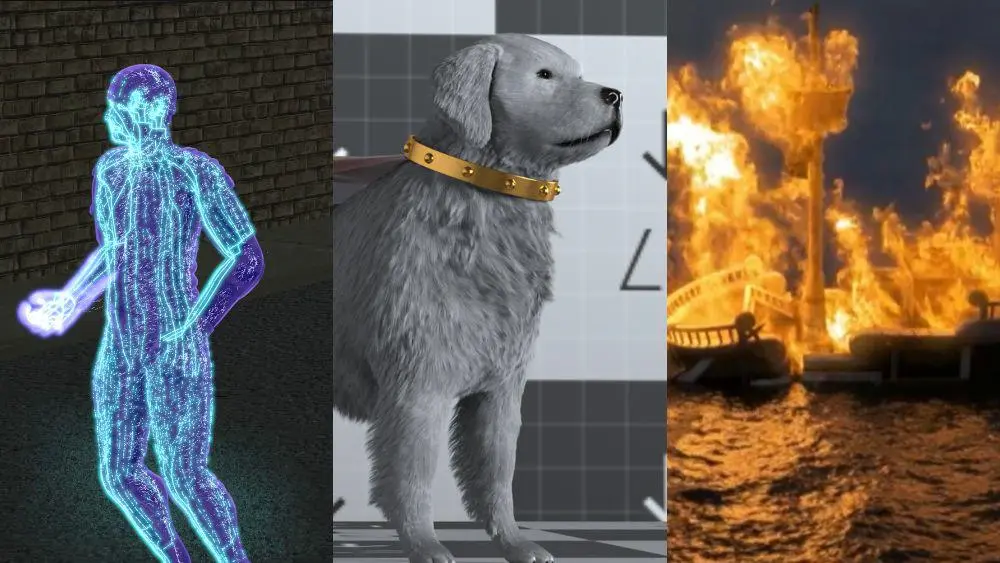
Three BA (Hons) CGI and Visual Effects students at Southampton Solent University have used industry-leading software to produce Final Major Projects of a professional, production-ready standard.
Jan Casling, Benjamin Theobalds and Harvey Lethbridge have each taken on a different creative and technical challenge but share a common determination to work at the level of a professional studio. All three projects were built in Houdini, the software of choice for many of the world's leading VFX studios.
Education and Training Manager at SideFX, John Moncief said: “The studios of tomorrow are being built in classrooms today. When students learn Houdini, they're not just learning software - they're learning the language of the industry. Our partnerships with universities like Solent are an investment in the next generation of artists who will define what's possible on screen. Industry-standard software. Industry-ready graduates. That's the partnership."
For Jan Casling, his FMP was deeply personal. He set out to recreate one of the most emotionally charged scenes in the beloved manga and anime series One Piece.
"One Piece is a huge part of who I am," Jan says. "When I watched it for the first time, I found myself sad and emotional over a pirate ship, and I wanted to bring that to life."
Rather than simply paying tribute to the original, Jan reimagined the scene as a live action CGI shot in the style of Netflix's own One Piece adaptation, complete with photorealistic fire, water simulations and cinematic lighting.
The fire simulation alone required weeks of trial and error, with Jan drawing on reference footage of burning barns and ocean fires to achieve the right look.
"Because of this single simulation I gained a variety of new techniques and knowledge across the entire VFX pipeline." His ultimate career goal is to work on the Netflix live action One Piece production itself. You can view Jan’s work here.

Benjamin Theobalds took a different path, one that led him into the microscopic world of hair and fur. For his FMP, Benjamin created a photorealistic fur groom of Krypto the Super Dog from DC’s Superman. The project explored clumping, flyaway hair, light refraction, melanin, and pigmentation to achieve a believable digital dog coat.
Originally drawn to creature and character sculpture, Benjamin encountered Creature FX at the end of his second year and was immediately hooked. "I never thought I would find myself researching the different structures of hair strands and how they react to light during my time at university," he said.
Working in Houdini reshaped the way he approaches problems entirely. "Instead of seeing challenges as obstacles, now I see them as processes that can be tested, refined and solved step by step," he explains. He is proudest of the clumping in the final groom. The detail that, for him, made the fur truly convincing.
His ambition is to work as a CFX artist in film and advertising, specialising in realistic digital fur and creature work. You can view Benjamin's breakdown reel here.

Harvey Lethbridge's FMP centres on a cinematic VFX sequence exploring how to make electricity feel powerful, dangerous and physically real, drawing inspiration from the Marvel character Electro from the Spider-Man series.
To achieve this, Harvey used high-frequency noise patterns to drive particle behaviour, running them through collision objects attached to motion capture animation recorded at Solent's own motion capture suite. He utilised techniques shared by professional VFX artists, using curves, attributes, frequencies and layered secondary effects to create a more dynamic and believable result.
Harvey says that one of the aspects of the project that felt closest to industry practice was the feedback and project management process, involving notes from lecturers, peers, online communities, and industry artists alongside the coordination of animation, simulation, rendering, compositing, and sound.
After graduation, Harvey plans to continue developing his portfolio while travelling and building industry connections, with a long-term ambition to work in procedural VFX and technical art. You can view Harvey's work here and here.

All three students credit Solent with giving them the knowledge, confidence and industry connections to take the next step. Each of them leaves university not just with a degree, but with a professional-level portfolio of real work and hands-on experience of the tools and workflows used in VFX studios globally.
BA (Hons) CGI and Visual Effects at Solent equips students with the technical skills and creative thinking demanded by today's VFX industry, with courses designed around real-world outcomes and direct engagement with industry professionals. You can explore more about CGI and Visual Effects degree at Solent on our website.
Solent has awarded the Erasmus Charter for Higher Education, opening exciting opportunities for staff and students.
30 September 2026
Exeed College and Solent agree partnership to deliver degrees across the Middle East
29 September 2026
Interior Design at Solent has been ranked eighth in the UK in the Guardian Good University Guide 2027
17 September 2026
Solent’s BEng (Hons) Renewable Energy Engineering course has been accredited by the Institution of Engineering and Technology (IET).
4 September 2026