“I enjoy learning and testing new technologies - each day can be different and I like customer interaction.”



Develop sought-after practical skills in enterprise networking, automation and cloud technologies with this industry-focused course, delivered as part of the Cisco Networking Academy.
Contact international admissions
Email: Call:In partnership with the Cisco Networking Academy, the course will equip you with the practical skills required to design, implement, secure and manage computer network systems for business and industry – ranging from small businesses to large scale enterprise levels.
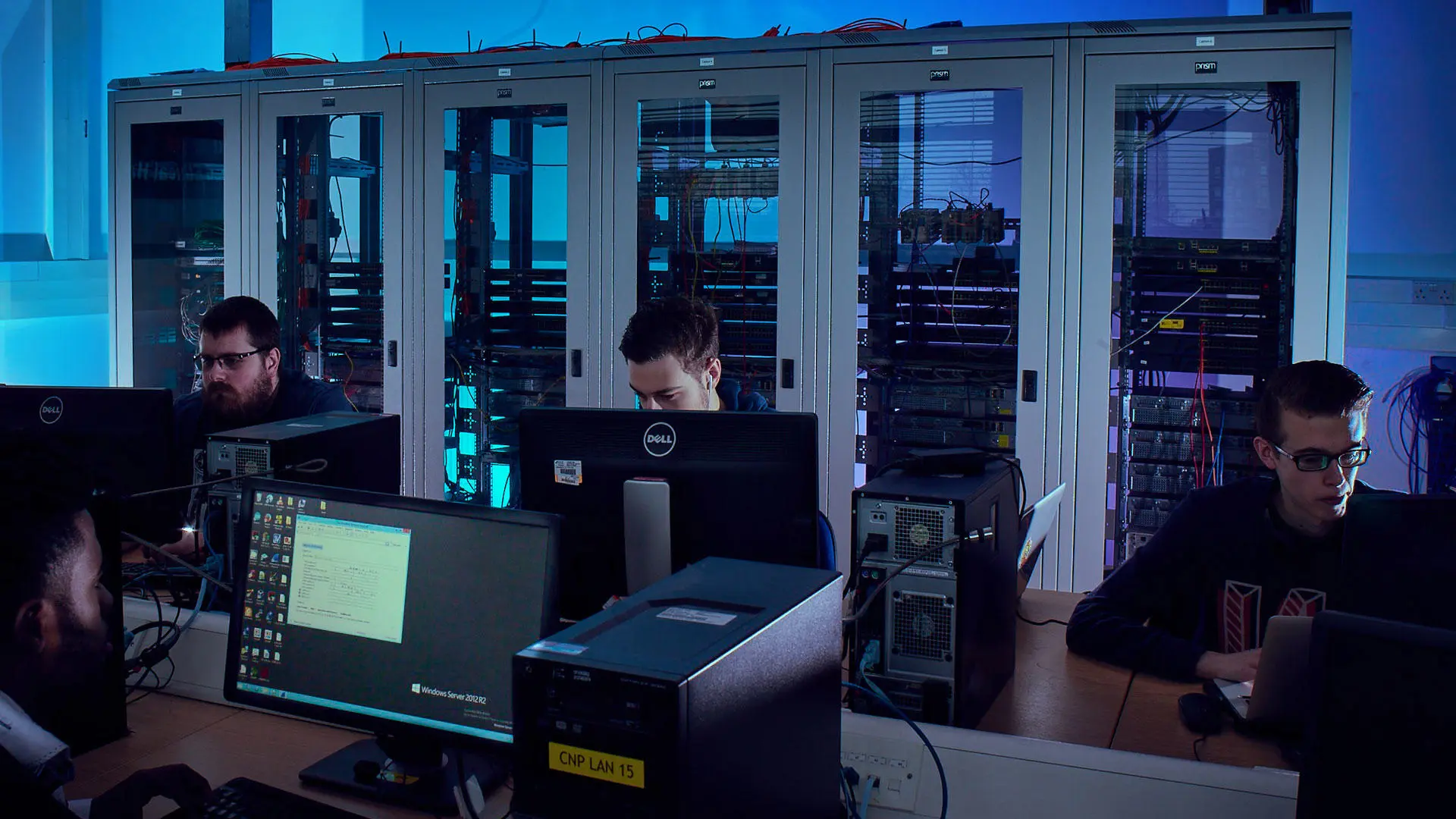
Throughout your studies, you will be working in our high-tech computer networking labs with industry standard facilities; featuring a wide variety of equipment including Cisco routers and switches, CCNA and CCNP bundles, multi-vendor network devices and high-performance servers. The lab machines are also equipped with a multitude of academic and commercial software including Cisco Packet Tracer, OPNet, VMWare, Open NMS, Wireshark, and GNS3 in Windows and Linux environments. The lab machines can also be configured flexibly to implement and test computer networks, and learn advanced technologies such as software-defined networks, cloud computing, virtualisation and the ‘Internet of Things’.
Your future employability is a key focus, and in addition to professional qualifications there are a broad range of transferable skills such as project management, problem-solving and communication skills embedded throughout – helping you to become highly employable.
If you’re looking to study our computer networks engineering degree but don’t have the relevant qualifications or experience, the STEM foundation year will help you develop the core skills and knowledge to progress. Find out more about the STEM foundation year.
This course also offers the option of a placement year. A placement year allows you to put what you've learned in your first and second years into practice in the workplace, gaining valuable real-world work experience before you graduate. Our course and placements teams will help you find the perfect industry placement in your chosen field.
This course is part of the South Coast Institute of Technology (IoT), a partnership of colleges, universities and industry-leading employers to create new career opportunities in the technology sector. IoT courses like this one are precisely tailored to the needs of employers in the maritime, engineering and digital industries – industries which are hungry for talented new engineers, technologists, technicians and creatives like you.
Accredited by:

Part of:

This course is designed for students who are curious about how digital systems connect and communicate, and who are interested in building and managing the networks that power modern organisations and the internet. It's ideal for those who enjoy practical problem-solving and want to develop technical skills in networking and infrastructure. No prior study of mathematics, computer science, or related technical subjects is required, as the programme begins with foundational modules that build your knowledge and confidence step by step.
Whether you're progressing from college, a vocational IT pathway, or returning to education to develop new digital skills, the course supports learners from a wide range of academic backgrounds who are motivated to pursue a career in network engineering and digital infrastructure.
Recent course graduates have gone on to various roles in network infrastructure and system support organisations, including Cisco Systems, IBM, Juniper, Symantec Security UK, Hewlett Packard Enterprise, Electra networks, QinetiQ, Quostar, VeriFone, TalkTalk, Rackspace, Vodafone, Softcat and Peer 1 Hosting.
Hear from Solent alumni about where their careers have taken them and how studying at Solent prepared them for their future.
Read more stories“I enjoy learning and testing new technologies - each day can be different and I like customer interaction.”
The course is delivered by a team of passionate, friendly and research-active qualified academics who work at the forefront of the field. Our academics are also fellows of the Higher Education Academy as well as Cisco certified instructors.
The University cannot guarantee any particular members of staff will teach specific aspects of the course in the future, but will endeavour to ensure the teaching team maintains their balance of experience and qualifications.
Dedicated specialist networking labs provide opportunities to work with a wide variety of real-world networking equipment from Cisco, Fluke and HP, as well as high-fidelity simulation systems including the market-leading Opnet.
You’ll also have access to our devices lab. This is a special test area integrated within one of our existing software development spaces. It consists of a range of mobile devices mounted on flexible tethers, giving you the chance to test your websites and apps on real equipment.
Broaden your horizons by adding an international dimension to your CV – essential to achieving success in today’s fast-changing, global environment.
Studying, working or volunteering in another country could be the experience of a lifetime. Enhance your degree by developing important global skills such as knowledge of other countries, language skills, intercultural awareness, adaptability and confidence.
For more information, please email international.mobility@solent.ac.uk.

This module provides the essential foundations of computing and programming for students entering software engineering and computer science. Through practice‑led activities such as live coding, pair programming, debugging labs, and guided exercises, you'll be introduced to how computers are structured and operate, how data is represented and processed, and how programs are designed, implemented and tested using a modern programming language.
In this module you'll investigate the function and management of operating systems and the services that run on networks to facilitate this communication between systems. You'll also look at how resilience and availability of systems and services can be provided and the consequence of system failures if these factors are not properly accounted for.
This module provides a practical introduction to computer networking and security, equipping you with the skills to design, configure, and secure networked systems. Emphasising real-world applications, what you learn in this module supports careers in IT, cybersecurity, and other sectors reliant on secure digital infrastructure.
This module will not only prepare you with the knowledge of foundational technologies, but also ensures you stay relevant with skill sets needed for the adoption of next generation technologies. You'll focus on switching technologies and router operations that support small-to-medium business networks, and through a combination of diverse instructional methods, you'll gain hands-on experience configuring switches, routers, and wireless devices using real-world equipment, industry-standard tools and simulation platforms.
This module introduces how artificial intelligence is reshaping network engineering and cyber security, and why AI literacy is now a core professional skill for both disciplines. You will learn to apply data-driven methods to model network behaviour, optimise routing and capacity, predict faults, and automate configuration and monitoring. You'll also explore AI-enabled security analytics: anomaly and intrusion detection, malware and phishing classification, and intelligent incident triage and response. Through hands-on labs using real network telemetry and security logs, you will evaluate techniques, interpret results, and communicate risk and limitations, including bias, adversarial manipulation and ethics.
This module provides you with the knowledge and practical skills to specify, design and implement large, connected networks. You will learn specifically about the requirements of, and how to implement network security, optimisation of network paths, and optimisation of the flow of data in networks. You'll also specify emerging technologies such as cloud, virtualisation and software defined networks, and will perform troubleshooting on networks and create and use documentation to solve issues.
This module introduces the principles, technologies, and architectural approaches used to design and defend secure enterprise networks. You will explore how network infrastructure can be hardened against attack through layered security architectures, secure device configuration, access control mechanisms, intrusion detection and prevention systems, and encrypted communications. The module emphasises defence-in-depth, secure network design, and the operational deployment of security controls across enterprise networks.
This module introduces you to network engineering principles based on Cisco CCNA knowledge and extends these skills to include network programmability, APIs, Infrastructure-as-Code, and DevOps practices. You'll also gain practical experience configuring network devices and automating network operations using Python, REST APIs, configuration management tools, and version control systems.
This module explores how network management practices and cybersecurity operations are integrated in real operational environments. You will learn how network telemetry, log analysis, threat intelligence, and security monitoring tools are used to detect anomalies, investigate incidents, and respond to attacks. Through practical laboratories and case-study exercises, you will develop skills in network monitoring, intrusion detection, security analytics, incident response, and operational decision-making.
In this module you'll gain practical experience working with employers, industry speakers, entrepreneurs, and external organisations. You will collaborate in development teams on an industry‑set brief, applying digital and technology skills while developing project management, communication, and professional behaviours. Alongside consulting practice, you will explore entrepreneurial thinking by identifying opportunities, generating innovative solutions, and understanding how value is created within technical and digital contexts.
In this module you will manage your own project, from choosing a topic to producing the final report. You set aims and objectives, keep a project plan, and maintain documentation that records your research and development work. You'll be assigned a supervisor to guide the process, confirm the project scope, and approve ethical requirements.
Please note: Not all optional modules are guaranteed to run each year.
In this module you'll gain advanced, industry aligned knowledge across cloud computing, Internet of Things (IoT), edge systems and next generation emerging technologies. You will learn how to design, deploy and integrate cloud native architectures with IoT devices, edge intelligence, real time data pipelines, and technologies such as 5G, blockchain, digital twins, extended reality (XR), robotics, and autonomous systems.
This module investigates electronic offences committed against individuals, businesses, organisations, and governments, and examines their impacts, the measures taken to address them, and the processes for detection, investigation, and prosecution. You'll also learn how to write a digital forensic report and defend it in a court setting.
Contact international admissions
Email: Call:As part of this course, you will study one module at a time, giving you the chance to build a deeper understanding and see the results of your hard work more quickly. With regular assessments and feedback, rather than exams all at once, you’ll also benefit from improved focus, and a more manageable workload.
Learn more about block teaching
The student achievement team are on hand to help you succeed during your studies at Solent. They aim to contact you at key times during your time here with personalised information, advice and guidance, by email or phone.
The disability advice team provides information, advice and guidance for disabled students.
All students can access Succeed@Solent, Solent's online guide to getting better grades. It offers extensive, practical information and advice on topics such as academic writing, research and presentations.
Computer networks are the backbone of modern digital society, supporting everything from cloud services and online communication to finance, healthcare and global business operations. As organisations continue to expand their digital infrastructure, there is a significant global shortage of skilled network engineers, making this one of the most in-demand areas within the technology sector. Careers in network engineering are therefore highly valued and well rewarded, offering strong long-term prospects and opportunities for progression.
This course is designed to equip students with the practical, industry-relevant skills employers are seeking, including network design, routing and switching, infrastructure management, cloud networking and automation. Through hands-on laboratories and real-world scenarios, students develop the technical expertise and professional confidence needed to succeed in this high-demand field.

Entry level £19,000 to £20,000
With experience, you can expect to earn around £35,000 to £55,000+.
Starting salary £18,000 to £25,000
After gaining experience, it's possible to progress to earnings of around £26,000 to £35,000. Technical support managers can earn over £40,000.
Starting salary £20,000 and £30,000
With experience you can earn between £40,000 and £65,000, rising to £70,000 for senior and team leader roles. However, this figure can be significantly higher depending on the industry you work in.
The stated salaries are published on prospects.ac.uk. Income figures are intended as a guide only.
Hear from Solent alumni about where their careers have taken them and how studying at Solent prepared them for their future.
Read more stories“I enjoy learning and testing new technologies - each day can be different and I like customer interaction.”
The Solent Careers team is committed to getting students into great careers.
While you are studying, the team can help you with finding work experience or placements, link you with a mentor, check your CV, or offer one-to-one guidance.
We also have graduate job opportunities just for Solent graduates.

Top 25%
of UK unis for sustained employment
Longitudinal Educational Outcomes, 2025
Every student at Solent University will also have the option to study an additional Certificate in Practical Artificial Intelligence qualification alongside their course. Free of charge, the course ensures you'll be prepared for a fantastic and varied career after graduation.

Thinking about studying further than an undergraduate degree? Alumni can get 20% off their postgraduate study.

Advance your career with this cyber security conversion course, gain expert skills, industry insights, and hands-on experience to tackle real-world cyber threats and network security.
Find out moreThe tuition fees for the 2027/28 academic year are:
For further information, please visit our tuition fees page.
While most course costs are covered by your tuition fees, some essential resources and optional extras may need to be paid for separately. For advice on budgeting and managing your money, please contact student.funding@solent.ac.uk.
The additional costs for this academic year are not yet available. For guidance, previous additional costs have been:
Optional costs:
Solent University offers a range of bursaries and scholarships that provide financial assistance or waive fees for tuition or accommodation. Each bursary or scholarship has specific eligibility criteria. Check out our bursaries and scholarships pages to find out more.
Cost of living support
At Solent, we understand that the cost of living crisis may be of some concern. To help, we've put together some detailed information to show what support is available and how to make your money go further.
Graduation costs
There is no charge to attend graduation, but you will be required to pay for the rental of your academic gown (approximately £45 per graduate, depending on your award). You may also wish to purchase official photography packages, which range in price from £15 to £200+. Graduation is not compulsory, so if you prefer to have your award sent to you, there is no cost. Extra guest tickets will go on sale after results publication and will be sold on a first-come-first-served basis. The cost per ticket is currently £20. Please note, we do not guarantee there will be any extra tickets available to purchase.
Contact international admissions
Email: Call:Please select an option below:
As a general guide, we look for qualifications that are equivalent to the British high school A-levels.
If you are applying from outside the UK, find information about entry requirements, visas and agents for your country here.
For further information about EU qualifications, please see our course entry requirements document.
For international students who do not meet the direct entry requirements for this undergraduate degree, our trusted partner, QA Higher Education offers the following pathway programme designed to develop your academic and English language skills:
As a general guide, we look for qualifications that are equivalent to the British high school A-levels.
If you are applying from outside the UK, find information about entry requirements, visas and agents for your country here.
For further information about international qualifications, please see our course entry requirements document.
For international students who do not meet the direct entry requirements for this undergraduate degree, our trusted partner, QA Higher Education offers the following pathway programme designed to develop your academic and English language skills:
All international applicants need to be aware that the English language requirements to attend Solent University, and the English language requirements to obtain a visa from the Home Office, may be different. This means that if you meet the Solent University language requirement to gain a place on the course, you may still have to meet additional requirements to be granted with a visa by the Home Office.
We strongly advise all applicants to visit the Home Office website which outlines all the requirements for a successful visa application
Full-time
Any student applying for the first year of a full-time/sandwich undergraduate course must apply through UCAS (University and Colleges Admissions Service). This includes mature, overseas and EU students.
Nearly all schools and colleges offer their students the facility of applying electronically through the UCAS website using 'Apply'; it may also be used by those applying independently in the UK and overseas. This facility and all course information can be found on the UCAS website: www.ucas.com.
Your application should reach UCAS by 14 January if you hope to enter a course the following autumn. Early application is advised for the most popular subject areas. Late applications may be made until the end of June. The UCAS Code for the University is S30, code name SOLNT.
Find out what happens after you apply
Contextual offers
Solent endeavours to offer learning opportunities to students from all backgrounds. When we receive and review an application, we take into consideration the context and personal circumstances of applicants when making a decision, which means our advertised entry tariff could be reduced.
Find out more about Solent's contextual offers
Top-up route:
We welcome applications from students currently studying a Foundation Degree, DipHE, HNC, HND or modules of an undergraduate degree course at another university, who wish to enter directly into Years 2 or 3 of one of our undergraduate degree courses. Please contact our admissions team for more information: contact us
Applicants who do not have English as their first language will be required to demonstrate an approved level of proficiency in the use of the English language. The agreed minimum requirements for this course are:
TOEFL IBT tests taken prior to 21 January 2026
TOEFL IBT tests taken from 21 January 2026
Qualifications are checked before enrolment, and international students must bring their original certificates or certified copies when coming to study at the University.
Pre-Sessional English programme
The University also offers a pre-sessional English programme for international students who wish to improve their level of English before starting a degree course.
Contact international admissions
Email: Call: