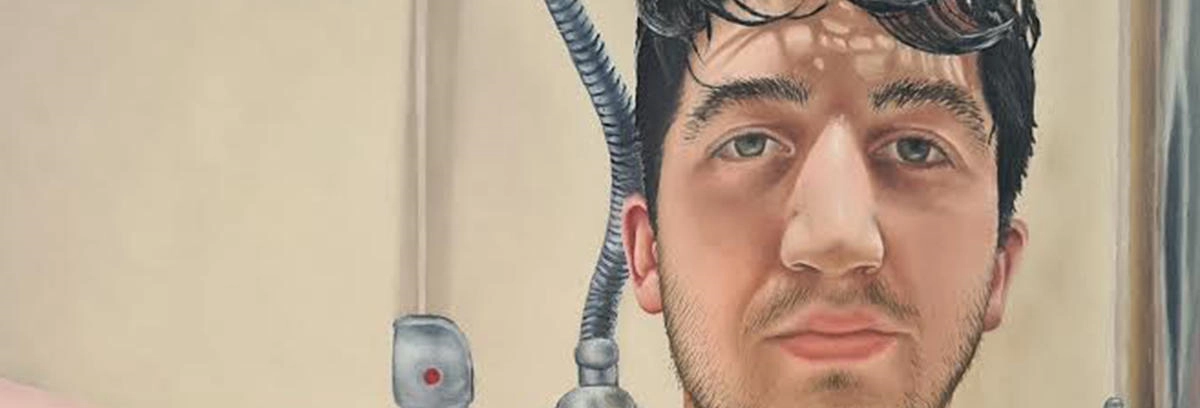
“I enjoyed having the full support of the fine art lecturers on the course.”

Nurture your talent for painting, sculpture or applied art, guided by a passionate team of artists, curators and theorists, in a supportive, creative community.
Contact international admissions
Email: Call:The BA (Hons) Fine Art degree is a progressive and unique student-centred fine art course that enables you to develop, define and perfect your skills as a professional artist.
This immersive, practice-led experience course embraces all possible forms of artistic mediums and while you will be given opportunities to familiarise yourself with contemporary and historical art and their theories, you are also encouraged to find your own unique voice as an artist. You’ll work in an environment where you’ll be supported to nurture and cultivate your artistic potential and grow into confident makers and thinkers, able to navigate through contemporary art and its related fields, such as art curation, art education, and art criticism.
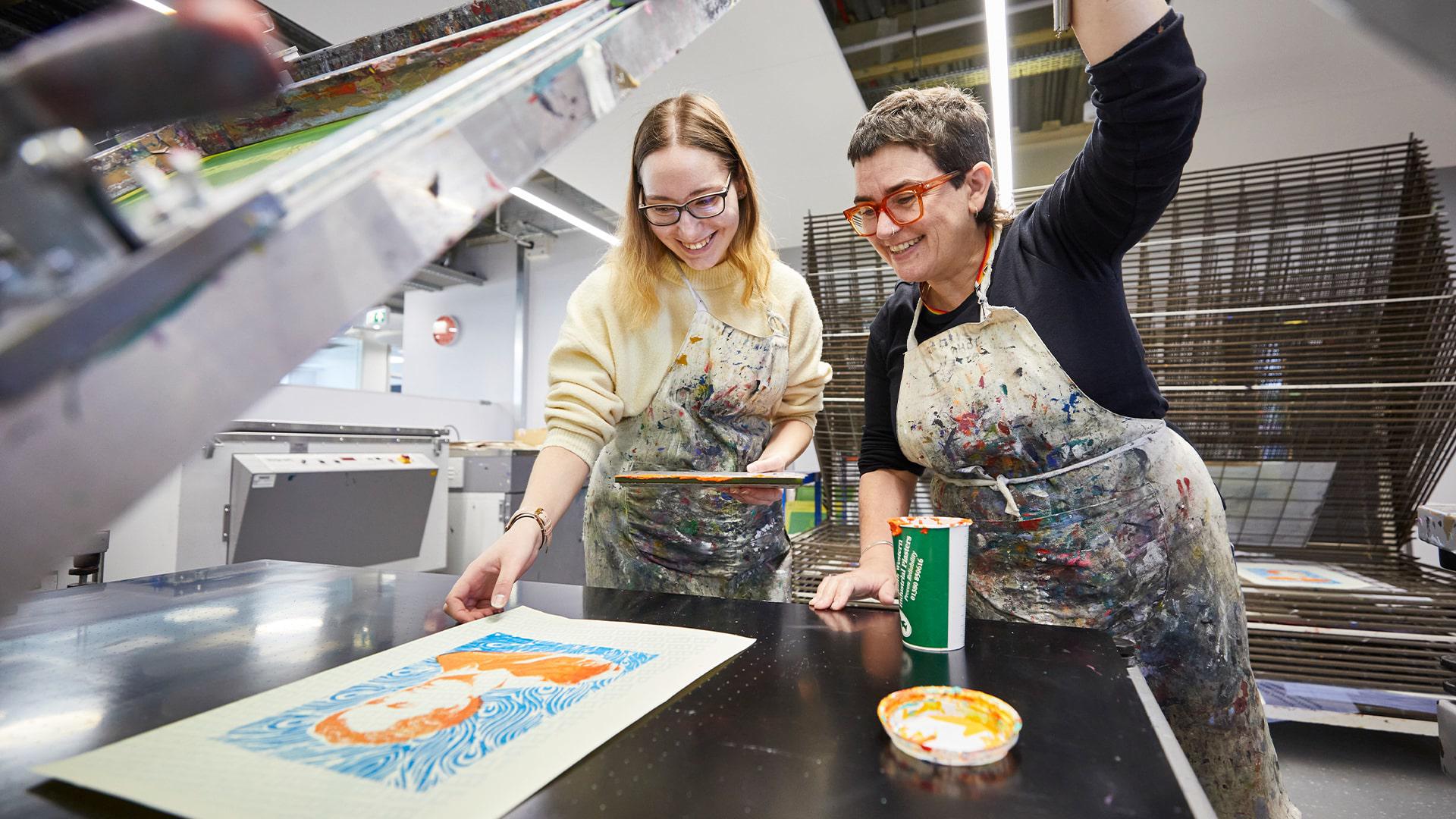
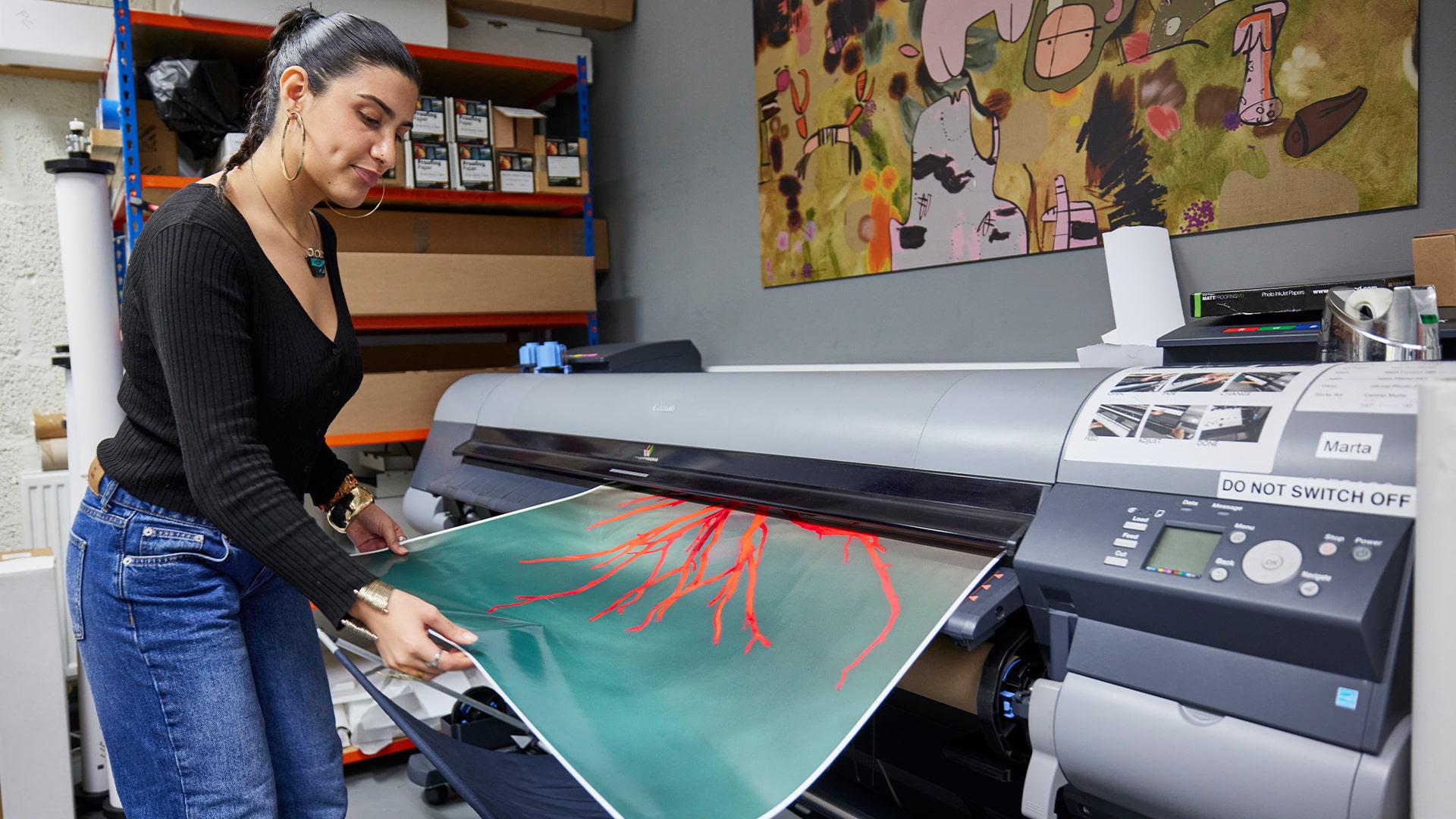
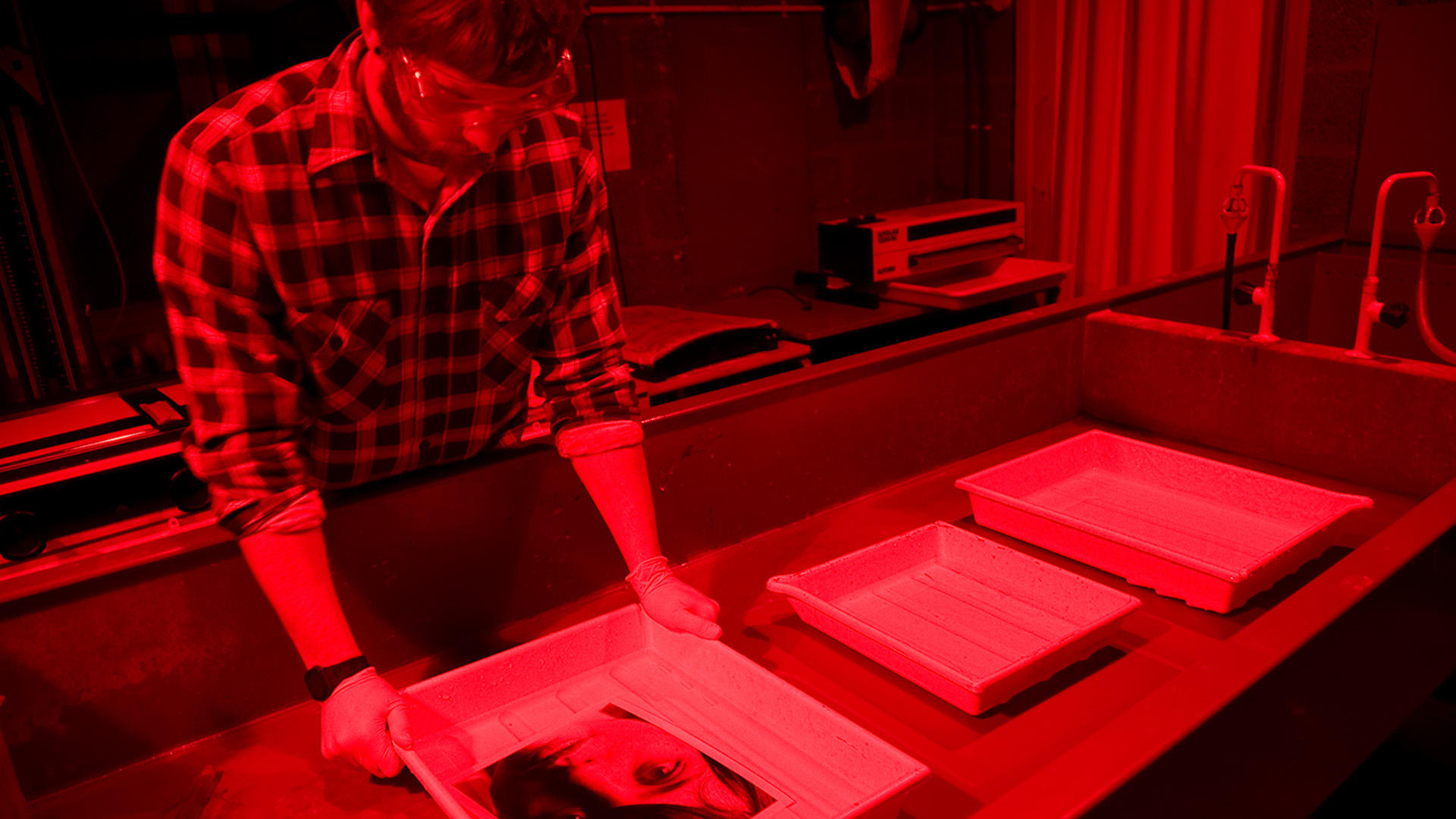
Our dedicated fine art studios are equipped to enable you to accomplish your talent through craft. You’ll be allocated personal studio space and have full access to a range of specialist workshops including sculpture with woodworking and casting equipment; print-making with intaglio, dry point, etching, silkscreen, woodcut and letterpress facilities; and a digital print workshop with high-quality large-scale print facilities, high-end scanners and the latest software; as well as photography darkrooms and studios.
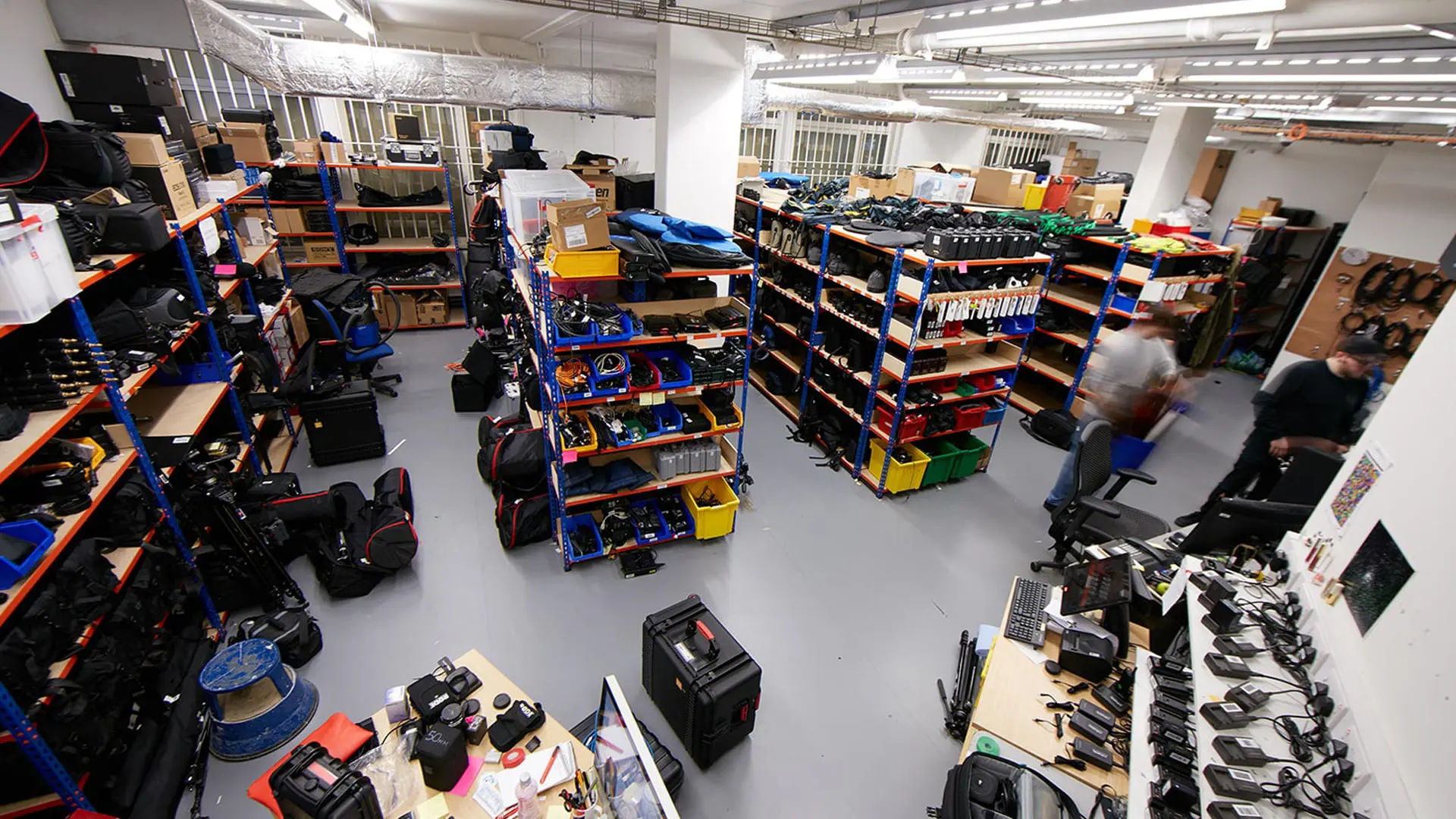
You’ll also have access to our media academy facilities, which boasts Mac suites with the latest design software, as well as a media store containing high-definition cameras, video cameras, and sound equipment.
The course has strong industry and community links and you will be given the opportunity to engage in an ambitious programme of professional development alongside your own individual artistic practice - for example, previous students have developed an online profile and designed and ran group exhibitions at a professional gallery within the city.
If you’re looking to study our fine art degree but don’t have the relevant qualifications or experience, the art and design foundation year will help you develop the core skills and knowledge to progress. Find out more about the art and design foundation year.
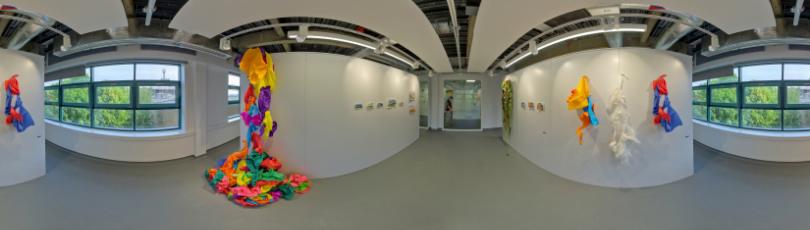
The fine art programme at Solent is ideally suited to students who are interested in refining their artistic skills and familiarising themselves with theoretical frameworks in art.
Applicants should demonstrate a basic level skill set in artistic mediums, and some level of contextual understanding of art practice.
The course is designed to nurture your unique approach and help you grow into a professional artist, film-maker, photographer or performance artist; but also provides support in developing a wide range of exciting career paths, such as art critic, art journalist, writer or poet, theorist, lecturer, school teacher, or art therapist.
Hear from Solent alumni about where their careers have taken them and how studying at Solent prepared them for their future.
Read more stories“I enjoyed having the full support of the fine art lecturers on the course.”
The University cannot guarantee any particular members of staff will teach specific aspects of the course in the future, but will endeavour to ensure the teaching team maintains their balance of experience and qualifications.
You will be allocated personal studio space within our specially designed and recently refurbished artists’ studios, and have access to a range of dedicated specialist workshops. Facilities include a sculpture workshop with woodworking and casting equipment; print-making workshop with intaglio, dry point, etching, silkscreen, woodcut and letterpress facilities; a digital print workshop with high-quality, large-scale print facilities, high-end scanners and the latest software; as well as photography darkrooms and studios.
You will also have access to our media academy, featuring Mac suites outfitted with the latest design software, and a media store containing high-definition cameras and video cameras, sound equipment and more.
Broaden your horizons by adding an international dimension to your CV – essential to achieving success in today’s fast-changing, global environment.
Studying, working or volunteering in another country could be the experience of a lifetime. Enhance your degree by developing important global skills such as knowledge of other countries, language skills, intercultural awareness, adaptability and confidence.
For more information, please email international.mobility@solent.ac.uk.
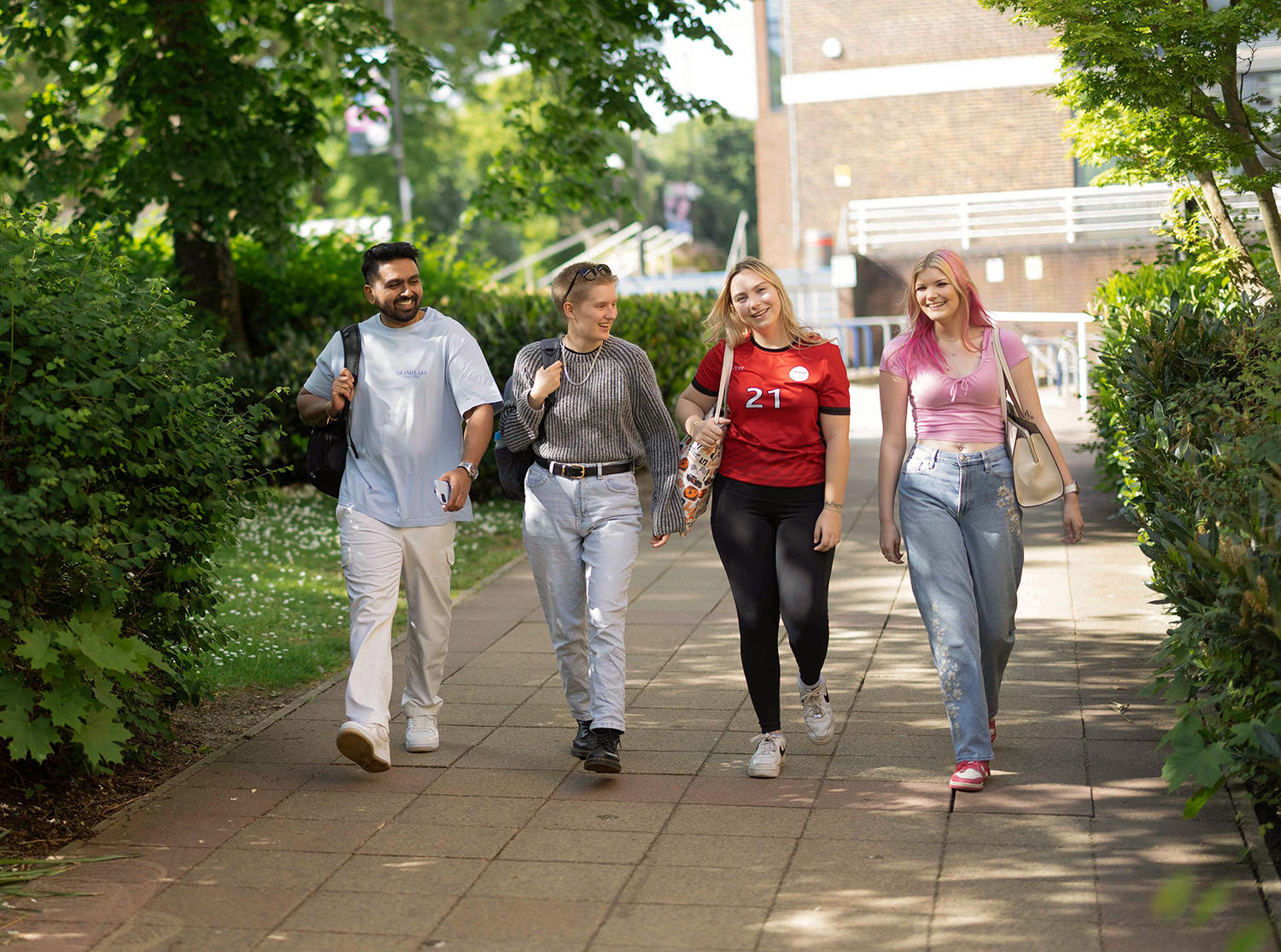
This module will support you with the start of your making journey - settling you into the studio culture, investing in your creativity, encouraging you to engage intellectually with artistic practice and begin to better understand visual language. You will build your confidence through reflecting on your practice, and communicating your thoughts and ideas with peers and tutors.
In this module you'll receive one-to-one support so you can grow stronger as an artist. Through a combination of individual tutorials and your own independent enquiry, you'll continue to explore and define your own practice to come to a greater understanding of your own motivations and passion for making art. Your practice should be underpinned by research and you will need to develop a context for your work - how does it relate to other artists' works and to current debates surrounding fine art?
In this module you will develop relevant artistic approaches and experiment to gain insight into your practice to progress your own unique making methods and thinking. Through testing, experimentation, acquiring skills, and communicating with others, you'll continue to develop a sense of agency over your practice.
During this module you will continue to explore relevant art methods, approaches, and experiments to gain further insight into a variety of approaches in art practice, and you will establish your own unique approach, methods and thinking. Through testing, experimenting, or acquiring skills and communicating with others, you are expected to develop an increasing sense of agency over your practice.
This module builds upon what was achieved in in your first year and is intended to enable you to grow as an individual, to help facilitate the development of your practice and to assist you in gaining greater confidence and independence as an artist. Throughout the module you'll broaden your outlook and perspectives on the subject of fine art and establish a direction through an open minded and exploratory approach.
This module enables you to continue to deepen your understanding of your practice and gain increasing self awareness as an artist. You'll be supported to establish a direction as a maker and as a thinker through an open-minded and exploratory approach. The synthesis of ideas, methods of production and appropriate technical skills will be the focus of this module.
Challenging you to traverse self-imposed technical and conceptual boundaries, this module encourages you to draw inspiration from diverse sources, and make in new ways. Through theoretical discourse and hands-on exploration, you will engage with diverse mediums and approaches, cultivating adaptability and resilience.
This module brings together all your learning, knowledge and experience up to this point through delivery of a public event or exhibition in collaboration with your peers. Through self-motivation and a commitment to hard work and your own practice, you'll be given the space to celebrate who you are becoming as an artist and the opportunity to make this known in a public forum.
In this module you will further develop your practical and contextual knowledge through taught sessions, as well as your own independent research and making. This module is important because within it, you can define yourself as an artist, coming to know the core issues central to your individual practice and finding the wider framework in which your work belongs.
This module will challenge you to think in imaginative and highly creative ways about your artistic practice. You'll be inspired through working in the studios and workshop spaces alongside other artists and will be encouraged to engage in research that inspires your practice through an increasingly independent programme of enquiry, curiosity and problem-solving. This module helps you to be a reflective practitioner, growing inwardly, but also socially and ethically in order to confront the challenges of the world and be outward facing in terms of community, industry and the global environment.
Alongside your continuing practice, this module will help you to write about visual things. As digital media has expanded the discussion of art worldwide, the ability to write with clarity and originality has never been so necessary. There is no single ‘best’ way to write about art and this module offers you the opportunity to think creatively about art writing. You will write a short form statement and present high quality imagery for inclusion in the catalogue which will accompany your degree show.
This module is the culmination of your undergraduate study. You have developed your knowledge of contemporary art in terms of your practice, technique, and context, and you will be channelling your skills and thinking towards a set of final works for the conclusive assessment.
Contact international admissions
Email: Call:As part of this course, you will study one module at a time, giving you the chance to build a deeper understanding and see the results of your hard work more quickly. With regular assessments and feedback, rather than exams all at once, you’ll also benefit from improved focus, and a more manageable workload.
Learn more about block teaching
The student achievement team are on hand to help you succeed during your studies at Solent. They aim to contact you at key times during your time here with personalised information, advice and guidance, by email or phone.
The disability advice team provides information, advice and guidance for disabled students.
All students can access Succeed@Solent, Solent's online guide to getting better grades. It offers extensive, practical information and advice on topics such as academic writing, research and presentations.
Historically art has occupied a crucial role in driving knowledge, technology and ideas forward. Art can take a significant role in communicating progressive ideas to envision and shape societies.
As a fine artist, you may specialise in a type of art, for example, landscapes, portraits or abstract art. You may work cross different subjects and mediums such as painting, sculpture, print-making, video or photography.
Through expressive and communicative means, artists contribute to the social bodies such as museums, galleries, schools and communities. You could be exhibiting your work in professional art galleries, or running curatorial projects, delivering educational workshops or after further training even provide arts-based therapeutic workshops within the local community.
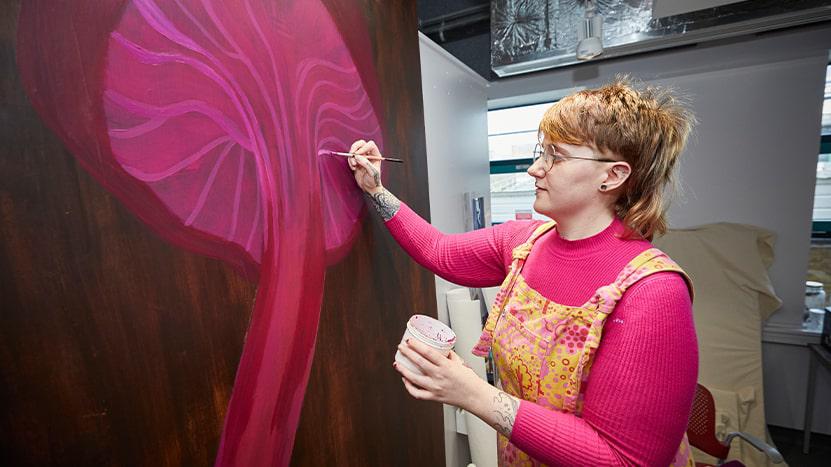
Per commission £1,000 - £2,000
Values can vary depending on the size and intricacy of the piece. You can expect to increase your prices with experience. The increase could vary between 10 and 20% with every major achievement, such as a sell-out show or winning an award.
Average salary: £25,000 to £30,000
Salaries for experienced arts administrators may rise to between £28,000 and £35,000. Senior arts administrators or those in larger organisations may earn £40,000 or more, particularly in London or in management-focused roles.
Starting salary: £19,000
This can rise to £29,000+ once you've built up experience. Senior executives at local government or arts agencies can earn salaries of over £40,000, but these roles require significant experience and are mainly strategic.
Newly qualified: £39,959
Jobs in the NHS are usually covered by the Agenda for Change (AfC) Pay Rates. Experienced NHS art therapists can earn between £49,387 and £56,515 (Band 7), with salaries for senior and principal roles ranging from £57,528 to £64,750 (Band 8a).
Early career: £25,000 to £32,000
As a middle-ranking conservator, you can expect to earn between £35,885 and £46,704 (average £39,100). This rises to between £42,185 and £52,000 (average £48,103) for senior conservator roles.
The stated salaries are published on prospects.ac.uk.
Hear from Solent alumni about where their careers have taken them and how studying at Solent prepared them for their future.
Read more stories“I enjoyed having the full support of the fine art lecturers on the course.”
The Solent Careers team is committed to getting students into great careers.
While you are studying, the team can help you with finding work experience or placements, link you with a mentor, check your CV, or offer one-to-one guidance.
We also have graduate job opportunities just for Solent graduates.

Top 25%
of UK unis for sustained employment
Longitudinal Educational Outcomes, 2025
Every student at Solent University will also have the option to study an additional Certificate in Practical Artificial Intelligence qualification alongside their course. Free of charge, the course ensures you'll be prepared for a fantastic and varied career after graduation.

Thinking about studying further than an undergraduate degree? Alumni can get 20% off their postgraduate study.
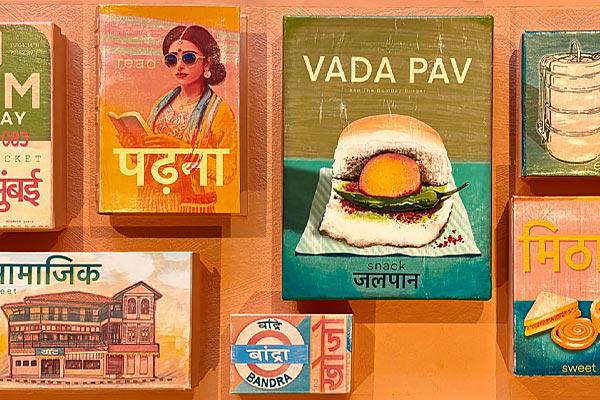
Do you have an eye for design? Would you like to help influence the future of visual communications? Our MA Visual Communication degree is ideal for creatives keen to refine their practice, working as part of an interdisciplinary group of students.
Find out more
Take charge and lead a wealth of fashion and beauty brands to success with your innovative and creative vision on this practice-based master's degree.
Find out moreThe tuition fees for the 2027/28 academic year are:
For further information, please visit our tuition fees page.
While most course costs are covered by your tuition fees, some essential resources and optional extras may need to be paid for separately. These additional costs are listed below. For advice on budgeting and managing your money, please contact student.funding@solent.ac.uk.
The additional costs for this academic year are not yet available. For guidance, previous additional costs have been:
Compulsory costs
Optional costs
Solent University offers a range of bursaries and scholarships that provide financial assistance or waive fees for tuition or accommodation. Each bursary or scholarship has specific eligibility criteria. Check out our bursaries and scholarships pages to find out more.
Cost of living support
At Solent, we understand that the cost of living crisis may be of some concern. To help, we've put together some detailed information to show what support is available and how to make your money go further.
Graduation costs
There is no charge to attend graduation, but you will be required to pay for the rental of your academic gown (approximately £45 per graduate, depending on your award). You may also wish to purchase official photography packages, which range in price from £15 to £200+. Graduation is not compulsory, so if you prefer to have your award sent to you, there is no cost. Extra guest tickets will go on sale after results publication and will be sold on a first-come-first-served basis. The cost per ticket is currently £20. Please note, we do not guarantee there will be any extra tickets available to purchase.
Contact international admissions
Email: Call:Please select an option below:
As a general guide, we look for qualifications that are equivalent to the British high school A-levels.
Applicants from outside the UK will be required to submit an electronic portfolio for consideration.
If you are applying from outside the UK, find information about entry requirements, visas and agents for your country here.
For further information about EU qualifications, please see our course entry requirements document.
For international students who do not meet the direct entry requirements for this undergraduate degree, our trusted partner, QA Higher Education offers the following pathway programme designed to develop your academic and English language skills:
As a general guide, we look for qualifications that are equivalent to the British high school A-levels.
Applicants from outside the UK will be required to submit an electronic portfolio for consideration.
If you are applying from outside the UK, find information about entry requirements, visas and agents for your country here.
For further information about UK, EU and international qualifications, please see our course entry requirements document.
For international students who do not meet the direct entry requirements for this undergraduate degree, our trusted partner, QA Higher Education offers the following pathway programme designed to develop your academic and English language skills:
All international applicants need to be aware that the English language requirements to attend Solent University, and the English language requirements to obtain a visa from the Home Office, may be different. This means that if you meet the Solent University language requirement to gain a place on the course, you may still have to meet additional requirements to be granted with a visa by the Home Office.
We strongly advise all applicants to visit the Home Office website which outlines all the requirements for a successful visa application.
Full-time
Any student applying for the first year of a full-time/sandwich undergraduate course must apply through UCAS (University and Colleges Admissions Service). This includes mature, overseas and EU students.
Nearly all schools and colleges offer their students the facility of applying electronically through the UCAS website using 'Apply'; it may also be used by those applying independently in the UK and overseas. This facility and all course information can be found on the UCAS website: www.ucas.com.
Your application should reach UCAS by 14 January if you hope to enter a course the following autumn. Early application is advised for the most popular subject areas. Late applications may be made until the end of June. The UCAS Code for the University is S30, code name SOLNT.
Find out what happens after you apply
Contextual offers
Solent endeavours to offer learning opportunities to students from all backgrounds. When we receive and review an application, we take into consideration the context and personal circumstances of applicants when making a decision, which means our advertised entry tariff could be reduced.
Find out more about Solent's contextual offers
Top-up route:
We welcome applications from students currently studying a Foundation Degree, DipHE, HNC, HND or modules of an undergraduate degree course at another university, who wish to enter directly into Years 2 or 3 of one of our undergraduate degree courses. Please contact our admissions team for more information: contact us
Applicants who do not have English as their first language will be required to demonstrate an approved level of proficiency in the use of the English language. The agreed minimum requirements for this course are:
TOEFL IBT tests taken prior to 21 January 2026
TOEFL IBT tests taken from 21 January 2026
Qualifications are checked before enrolment, and international students must bring their original certificates or certified copies when coming to study at the University.
Pre-Sessional English programme
The University also offers a pre-sessional English programme for international students who wish to improve their level of English before starting a degree course.
Contact international admissions
Email: Call: