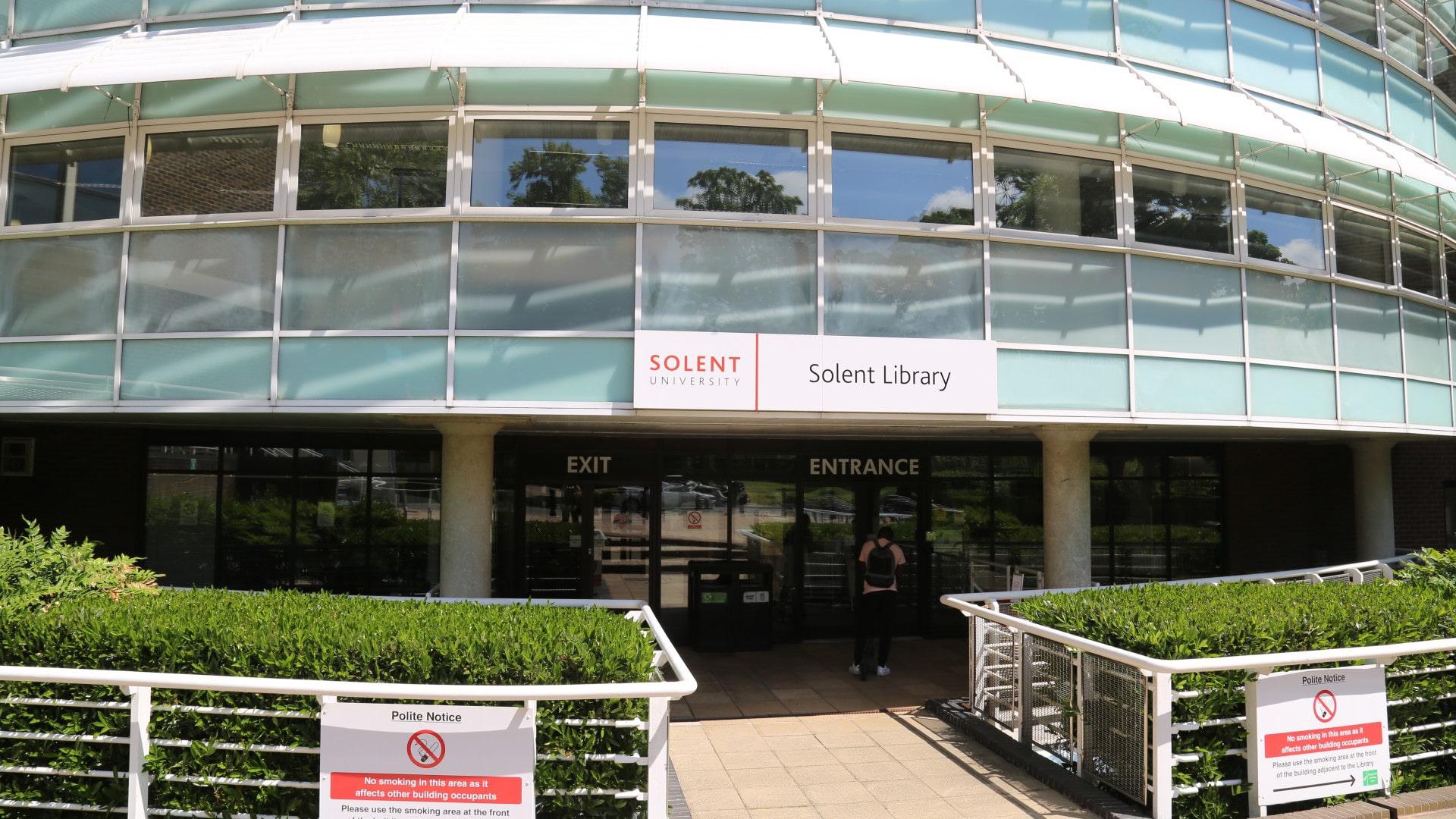
“Learning computing was obviously a massive help with my job choice now, but Solent wasn’t just about the degree.”



Find your specialism on this BCS-accredited degree. Gain problem-solving skills, create innovative technologies, build intelligent systems, and prepare for a career leading in AI-enabled industries.
Contact international admissions
Email: Call:The BSc (Hons) Computer Science is a future‑focused degree designed for students who want to shape the next generation of intelligent technologies. You’ll build a strong foundation in programming, algorithms, networking, and cybersecurity before progressing into advanced areas such as artificial intelligence, machine learning, and data‑driven computing.
As you move through the course, you’ll specialise in the technologies transforming the global digital economy. Whether your interests lie in cloud computing, IoT, natural language processing, generative AI, cloud security and automation, or autonomous systems, you’ll develop the expertise needed to thrive in high‑growth sectors.
Throughout the programme, you’ll work on practical, industry‑aligned projects that build a strong professional portfolio. By the time you graduate, you’ll be equipped with the technical skills, creative problem‑solving abilities, and innovative mindset required to succeed in AI‑enabled industries.
If you’re looking to study our computer science degree but don’t have the relevant qualifications or experience, the STEM foundation year will help you develop the core skills and knowledge to progress. Find out more about the STEM foundation year.
This course also offers the option of a placement year. A placement year allows you to put what you've learned in your first and second years into practice in the workplace, gaining valuable real-world work experience before you graduate. Our course and placements teams will help you find the perfect industry placement in your chosen field.
This course is part of the South Coast Institute of Technology (IoT), a partnership of colleges, universities and industry-leading employers to create new career opportunities in the technology sector. IoT courses like this one are precisely tailored to the needs of employers in the maritime, engineering and digital industries – industries which are hungry for talented new engineers, technologists, technicians and creatives like you.
Accredited by:

Part of:
This degree is ideal for students who are curious about how intelligent systems and data‑driven technologies work, and who want to develop the expertise to engineer them. This course is for you if you enjoy problem‑solving, are fascinated by artificial intelligence and data, and are motivated to design, build, and scale the computational systems shaping the modern world.
You do not need prior programming experience, the course is designed to take you from foundational principles through to advanced specialisation. What matters most is analytical thinking, intellectual curiosity, and a commitment to developing technical mastery.
Applicants from all educational backgrounds are welcome, and the block‑teaching model provides structured support for students from both traditional and non‑traditional pathways.
Graduates are prepared for a diverse range of high-value roles in a global economy increasingly defined by artificial intelligence, data, and cloud-native systems. The programme's focus on intelligent systems, machine learning, and advanced computational methods ensures graduates are equipped for specialised, future-facing careers.
Recent course graduates have gone on to various roles in the software industry, in roles at organisations such as IBM, Si Digital, LeadStream, Fujitsu UK and Guernsey Post.
Hear from Solent alumni about where their careers have taken them and how studying at Solent prepared them for their future.
Read more stories“Learning computing was obviously a massive help with my job choice now, but Solent wasn’t just about the degree.”
Learn from a specialist academic team with broad expertise across AI, data science, cybersecurity, and software engineering.
The University cannot guarantee any particular members of staff will teach specific aspects of the course in the future, but will endeavour to ensure the teaching team maintains their balance of experience and qualifications.
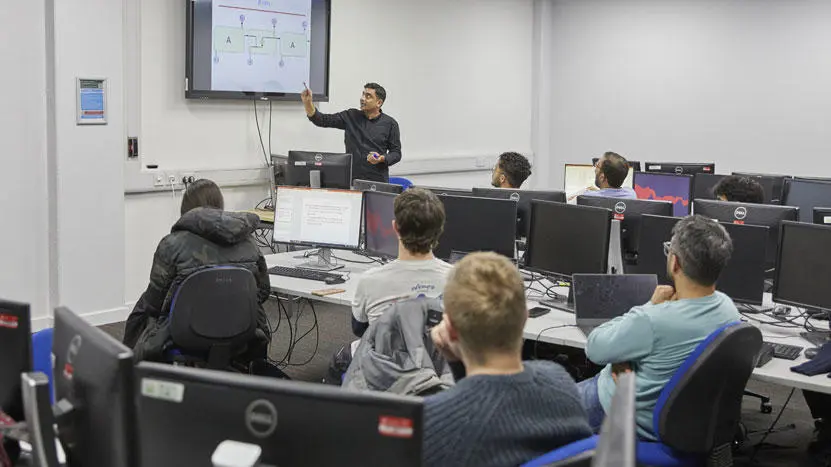
We have up-to-date IT laboratories and a usability lab with eye-tracking facilities, used to test and refine interfaces. Students also have the opportunity to learn to program robotic devices such as robotic arms and drones, and can develop apps for android devices. You’ll have access to our devices lab, a special test area integrated within one of our existing software development spaces. It consists of a range of real mobile devices mounted on flexible tethers, giving you the chance to test your websites and apps on real equipment.
Our vibrant campus brings state-of-the-art facilities to enhance your learning and elevate your student experience. Our award-winning teaching building, The Spark is centred around students and offers a stimulating study environment with flexible learning spaces. Away from studying, why not try out the gyms, fitness studios and sports halls in our £28 million Sports Complex, or watch a blockbuster film at our student-run cinema with Dolby Atmos audio.
Broaden your horizons by adding an international dimension to your CV – essential to achieving success in today’s fast-changing, global environment.
Studying, working or volunteering in another country could be the experience of a lifetime. Enhance your degree by developing important global skills such as knowledge of other countries, language skills, intercultural awareness, adaptability and confidence.
For more information, please email international.mobility@solent.ac.uk.

This module provides the essential foundations of computing and programming for students entering software engineering and computer science. Through practice‑led activities such as live coding, pair programming, debugging labs, and guided exercises, you'll be introduced to how computers are structured and operate, how data is represented and processed, and how programs are designed, implemented and tested using a modern programming language.
This module provides an introduction to artificial intelligence alongside the core professional practices required for success in modern computing disciplines. You'll develop foundational AI literacy by exploring classical AI methods, intelligent agents, search strategies, data fundamentals and introductory machine-learning concepts. Through hands-on exploration of datasets, notebook-based activities and conceptual modelling tasks, you'll gain an applied understanding of how AI systems operate, where they are effective and what limitations or risks they present.
This module provides a practical introduction to computer networking and security, equipping you with the skills to design, configure, and secure networked systems. Emphasising real-world applications, what you learn in this module supports careers in IT, cybersecurity, and other sectors reliant on secure digital infrastructure.
This module introduces web development and relational data management, equipping you with the essential technical foundations required for building interactive, data‑driven digital systems. It brings together client‑side web technologies, server‑side data persistence, and core database design principles to create fully functional web applications and build the foundation for year two modules.
This module introduces the core principles and practical applications of applied artificial intelligence and machine learning. You'll begin by exploring descriptive data analysis and exploratory data analysis (EDA) techniques to examine datasets, identify patterns, and prepare data for machine learning tasks. You'll then examine key machine learning approaches, including supervised learning methods such as regression and classification, and unsupervised learning techniques including clustering and dimensionality reduction.
Following the introduction in year one, this module takes a wider-ranging and deeper look at object-oriented software development. Focusing on the full software development lifecycle, you will cover analysis, design, implementation and testing using an appropriate object-oriented language for an appropriate platform. You'll be expected to have prior experience in basic object oriented programming, either from previous study or elsewhere.
From classic websites to back-ends for mobile apps, the web is all-pervasive these days, and web development skills are in high demand. Web applications are typically backed by databases, and database design and development skills are also vital in web development. This module provides you with the database and web development skills necessary to build such applications. You are expected to have basic web development skills to study this module, i.e. HTML, CSS, and basic JavaScript or TypeScript, from either previous study or elsewhere.
This module will equip you with the technical and analytical skills required to transform raw data into actionable business intelligence. You'll address the growing industry demand for professionals who can analyse complex datasets using both statistical frameworks and computational tools and will move beyond static data viewing to a practice-led exploration of the analytics lifecycle, learning how to interpret results and justify analytical decisions within professional enterprise contexts.
This module provides a comprehensive exploration of modern data-driven intelligence, balancing the rigorous statistical foundations of advanced data science with the transformative power of deep learning. Designed for the final year of study, it shifts focus from basic implementation to the critical evaluation and synthesis of complex data pipelines and neural architectures. You will engage in intensive, practice-led learning to solve non-linear, real-world problems, ensuring you graduate as a 'creator of knowledge and critical solutions'.
In this module you'll gain practical experience working with employers, industry speakers, entrepreneurs, and external organisations. You will collaborate in development teams on an industry‑set brief, applying digital and technology skills while developing project management, communication, and professional behaviours. Alongside consulting practice, you will explore entrepreneurial thinking by identifying opportunities, generating innovative solutions, and understanding how value is created within technical and digital contexts.
In this module you will manage your own project, from choosing a topic to producing the final report. You set aims and objectives, keep a project plan, and maintain documentation that records your research and development work. You'll be assigned a supervisor to guide the process, confirm the project scope, and approve ethical requirements.
Please note: Not all optional modules are guaranteed to run each year.
In this module you'll gain advanced, industry aligned knowledge across cloud computing, Internet of Things (IoT), edge systems and next generation emerging technologies. You will learn how to design, deploy and integrate cloud native architectures with IoT devices, edge intelligence, real time data pipelines, and technologies such as 5G, blockchain, digital twins, extended reality (XR), robotics, and autonomous systems.
This module introduces the core principles and practical applications of natural language processing and generative artificial intelligence. You'll begin by exploring text preprocessing techniques to clean and prepare language data for analysis before examining core NLP techniques, including tokenisation and vectorisation, alongside classical models for text analysis and pattern extraction. Building on this foundation, you'll then explore generative AI concepts, working with large language models to produce and analyse text outputs.
This module provides an advanced examination of cloud‑native engineering, with a particular focus on the integration of automated deployment and secure architectural design. As organisations continue to adopt distributed and virtualised environments, the ability to engineer resilient, self‑healing systems becomes essential. You will develop the capability to design and deploy cloud infrastructures using Infrastructure‑as‑Code (IaC), automated CI/CD pipelines, and industry‑standard orchestration platforms.
This module provides an advanced exploration of artificial intelligence and autonomous systems, focusing on the design, evaluation and responsible deployment of intelligent agents operating in dynamic environments. You will develop the ability to engineer AI‑driven behaviours, integrate perception and decision‑making pipelines, and evaluate the safety, reliability and ethical implications of autonomous technologies.
Contact international admissions
Email: Call:As part of this course, you will study one module at a time, giving you the chance to build a deeper understanding and see the results of your hard work more quickly. With regular assessments and feedback, rather than exams all at once, you’ll also benefit from improved focus, and a more manageable workload.
Learn more about block teaching
The student achievement team are on hand to help you succeed during your studies at Solent. They aim to contact you at key times during your time here with personalised information, advice and guidance, by email or phone.
The disability advice team provides information, advice and guidance for disabled students.
All students can access Succeed@Solent, Solent's online guide to getting better grades. It offers extensive, practical information and advice on topics such as academic writing, research and presentations.
The global computing industry is in a period of profound transformation. Driven by the rapid expansion of artificial intelligence, cloud computing, and data-driven decision-making, organisations across every sector from healthcare and finance to aerospace and government are investing heavily in high-level computing talent.
The UK Government's National AI Strategy and the Tech Nation Digital Economy Report consistently identify a critical skills shortage in machine learning, data analytics, cloud security, and autonomous systems. This programme positions graduates at the centre of that demand. By embedding BCS-accredited technical excellence with industry-informed learning, the course ensures students are not passive observers of the digital revolution, they become the engineers who architect it.


Entry level £25,000 to £30,000
With a few years' experience you can expect to earn between £40,000 and £60,000 in a data scientist role. Lead and chief data scientists can earn upwards of £60,000, and in some cases £100,000+.
Graduate salary £22,000 to £31,000
With experience, you can earn over £38,000. At a more senior level, if you've identified a specialist area, salaries range from anywhere between £47,000 and £75,000.
Entry level £19,000 to £20,000
With experience, you can expect to earn around £35,000 to £55,000+.
Graduate entry level £35,000
With three to five years experience, this can rise to £50,000 to £80,000. At senior level or in a specialised or lead role, this can rise to £120,000. In some cases, even as much as £170,000 if you work for a large multinational company.
The stated salaries are published on prospects.ac.uk. Income figures are intended as a guide only.
Hear from Solent alumni about where their careers have taken them and how studying at Solent prepared them for their future.
Read more stories“Learning computing was obviously a massive help with my job choice now, but Solent wasn’t just about the degree.”
The Solent Careers team is committed to getting students into great careers.
While you are studying, the team can help you with finding work experience or placements, link you with a mentor, check your CV, or offer one-to-one guidance.
We also have graduate job opportunities just for Solent graduates.

Top 25%
of UK unis for sustained employment
Longitudinal Educational Outcomes, 2025
Every student at Solent University will also have the option to study an additional Certificate in Practical Artificial Intelligence qualification alongside their course. Free of charge, the course ensures you'll be prepared for a fantastic and varied career after graduation.

Thinking about studying further than an undergraduate degree? Alumni can get 20% off their postgraduate study.

Advance your career with this cyber security conversion course, gain expert skills, industry insights, and hands-on experience to tackle real-world cyber threats and network security.
Find out moreThe tuition fees for the 2027/28 academic year are not yet available. For guidance, the 2026/27 fees were:
For further information, please visit our tuition fees page.
While most course costs are covered by your tuition fees, some essential resources and optional extras may need to be paid for separately. For advice on budgeting and managing your money, please contact student.funding@solent.ac.uk.
Solent University offers a range of bursaries and scholarships that provide financial assistance or waive fees for tuition or accommodation. Each bursary or scholarship has specific eligibility criteria. Check out our bursaries and scholarships pages to find out more.
Cost of living support
At Solent, we understand that the cost of living crisis may be of some concern. To help, we've put together some detailed information to show what support is available and how to make your money go further.
Graduation costs
There is no charge to attend graduation, but you will be required to pay for the rental of your academic gown (approximately £45 per graduate, depending on your award). You may also wish to purchase official photography packages, which range in price from £15 to £200+. Graduation is not compulsory, so if you prefer to have your award sent to you, there is no cost. Extra guest tickets will go on sale after results publication and will be sold on a first-come-first-served basis. The cost per ticket is currently £20. Please note, we do not guarantee there will be any extra tickets available to purchase.
Contact international admissions
Email: Call:Please select an option below:
As a general guide, we look for qualifications that are equivalent to the British high school A-levels.
If you are applying from outside the UK, find information about entry requirements, visas and agents for your country here.
For further information about EU qualifications, please see our course entry requirements document.
For international students who do not meet the direct entry requirements for this undergraduate degree, our trusted partner, QA Higher Education offers the following pathway programme designed to develop your academic and English language skills:
As a general guide, we look for qualifications that are equivalent to the British high school A-levels.
If you are applying from outside the UK, find information about entry requirements, visas and agents for your country here.
For further information about international qualifications, please see our course entry requirements document.
For international students who do not meet the direct entry requirements for this undergraduate degree, our trusted partner, QA Higher Education offers the following pathway programme designed to develop your academic and English language skills:
All international applicants need to be aware that the English language requirements to attend Solent University, and the English language requirements to obtain a visa from the Home Office, may be different. This means that if you meet the Solent University language requirement to gain a place on the course, you may still have to meet additional requirements to be granted with a visa by the Home Office.
We strongly advise all applicants to visit the Home Office website which outlines all the requirements for a successful visa application
Full-time
Any student applying for the first year of a full-time/sandwich undergraduate course must apply through UCAS (University and Colleges Admissions Service). This includes mature, overseas and EU students.
Nearly all schools and colleges offer their students the facility of applying electronically through the UCAS website using 'Apply'; it may also be used by those applying independently in the UK and overseas. This facility and all course information can be found on the UCAS website: www.ucas.com.
Your application should reach UCAS by 14 January if you hope to enter a course the following autumn. Early application is advised for the most popular subject areas. Late applications may be made until the end of June. The UCAS Code for the University is S30, code name SOLNT.
Find out what happens after you apply
Contextual offers
Solent endeavours to offer learning opportunities to students from all backgrounds. When we receive and review an application, we take into consideration the context and personal circumstances of applicants when making a decision, which means our advertised entry tariff could be reduced.
Find out more about Solent's contextual offers
Top-up route:
We welcome applications from students currently studying a Foundation Degree, DipHE, HNC, HND or modules of an undergraduate degree course at another university, who wish to enter directly into Years 2 or 3 of one of our undergraduate degree courses. Please contact our admissions team for more information: contact us
Applicants who do not have English as their first language will be required to demonstrate an approved level of proficiency in the use of the English language. The agreed minimum requirements for this course are:
TOEFL IBT tests taken prior to 21 January 2026
TOEFL IBT tests taken from 21 January 2026
Qualifications are checked before enrolment, and international students must bring their original certificates or certified copies when coming to study at the University.
Pre-Sessional English programme
The University also offers a pre-sessional English programme for international students who wish to improve their level of English before starting a degree course.
Contact international admissions
Email: Call: