“Solent opened its SMART Centre during my course providing brilliant 3D printing facilities for engineers like me.”

Dylan Packham
Telecoms Satellite Payload Systems Degree Apprentice
Airbus, Defence and Space

With a strong focus on electronic design, this modern course allows you to progress in your electronic engineering career.
Contact international admissions
Email: Call:The electrical engineering industry has a wide-ranging impact on sectors such as manufacturing, automotive, aerospace, and robotics. Pursuing a career in electronic engineering allows individuals to be at the forefront of innovation, designing and developing the systems and machines that shape our world.
With a focus on practical training and skills development, Solent will prepare you to be a readily employable graduate across a range of diverse technical roles.
You'll develop your abilities in applying mathematical and scientific principles to analyse and solve electronic engineering problems, and be introduced to a range of electronic systems, components, and processes and their applications.
This course has been developed in collaboration with the South Coast Institute of Technology, providing partnerships with well known employers including The Royal Navy, Portsmouth International Port and Maritime UK Solent, who contribute to the economic growth of the South Coast.
On this course, you can also foster an appreciation of environmental sustainability, ethical conduct, safety, and professional standards in electronic engineering.
You can gain the academic foundation for further study in electronic engineering or related fields and work effectively as part of engineering teams through work-related learning.
Part of:

This foundation degree programme is ideal for those wishing to increase their academic knowledge and gain qualification in electronic engineering with a view to pursuing further study. A foundation degree is suitable for those who may not possess the qualifications to enter directly on to an undergraduate degree programme, or for those who are returning to education after a period of time.
With a growing need for qualified engineers to meet demands in several key industries, graduates will be well placed to be part of the next generation of engineers to fill vital jobs across the electronic engineering industry.
Graduates on this course can also join the final year undergraduate BEng Electronic Engineering course, subject to grades achieved.
Hear from Solent alumni about where their careers have taken them and how studying at Solent prepared them for their future.
“Solent opened its SMART Centre during my course providing brilliant 3D printing facilities for engineers like me.”
Telecoms Satellite Payload Systems Degree Apprentice
Airbus, Defence and Space
The University cannot guarantee any particular members of staff will teach specific aspects of the course in the future, but will endeavour to ensure the teaching team maintains their balance of experience and qualifications.
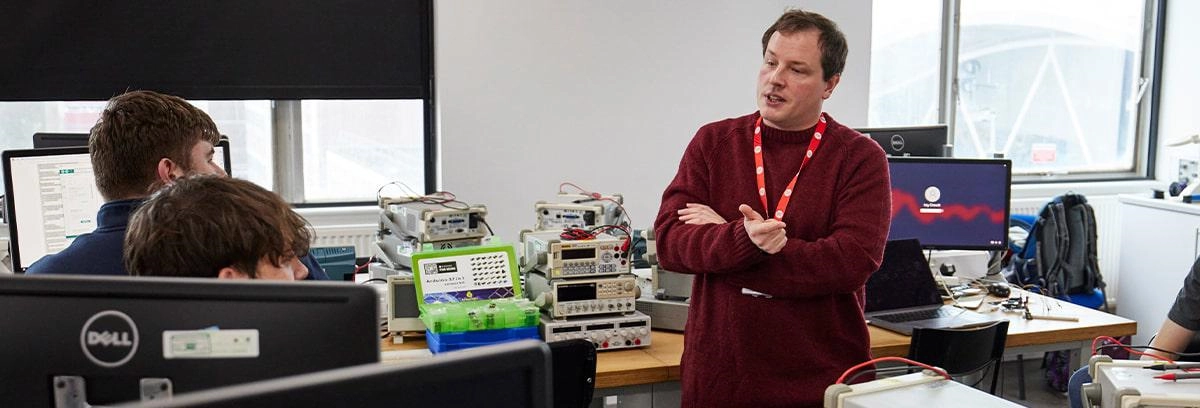
Electronic engineering students benefit from access to a range of high-end facilities including rapid prototyping equipment, PSpice/NI MultiSim software and microcomputer development systems. Solent University also offers students access to digital multi-meter signal generators, FLIR cameras and digital signal processing (DSP) boards – all of which allow students to better understand how the theory they have learnt links to real workplace scenarios.
Laboratories also include NI MultiSim eCAD software, rapid prototyping equipment with 3D printers and laser cutters, and a wide range of development systems for microcomputer and microcontroller systems.
Being an engineer is more than a job description or title – it is a profession with published standards, skills, ethical expectations, and regulatory structures. This includes theoretical, professional and applied skills relating to the role of the professional engineer. In this module you will develop your practical research, communication skills, and confidence through participation in a diverse range of activities and working in teams.
Engineering design and manufacture are the two most important and interlinked product development stages in the product life cycle. A correct design informed by manufacturing knowledge/constraints will result in few problems at later life cycle stages of the product. In this module, you'll gain an understanding of the fundamentals of the engineering design, and conventional and advanced manufacturing processes. You'll then apply this understanding by demonstrating practical computer-aided design and workshop skills to model and manufacture components.
This module introduces you to essential mathematics, electronic principles, and mechanical principles that underpin engineering systems. You'll develop skills in key areas of electronics and mechanics, along with the mathematical expertise required to analyse and solve engineering problems. You'll also gain practical skills enabling you to design, debug and verify electronic circuits including the use of simulation tools and further mechanical practical work will enable you to see engineering principles in action.
This module integrates advanced mathematical principles with hands-on engineering design. You will apply matrices, complex numbers, and calculus to solve engineering problems, reinforced by computational modeling and simulation. The curriculum emphasises the transition from theory to practice through analogue and digital electronics, utilising laboratory investigation and technical research to develop industry-standard design competencies essential for professional practice.
This module introduces contemporary tools, methodologies, and standards used in industry to develop reliable, efficient, and scalable embedded and networked systems. You'll gain a comprehensive understanding of the embedded systems development lifecycle, from digital logic design and hardware description through to system implementation and verification, alongside the principles of data communication and networking that enable system connectivity.
This module develops your capability to apply engineering principles to the design, analysis, and integration of robotics and automation systems. Working in multidisciplinary teams, you'll work together to tackle a complex engineering challenge, naturally creating a systems engineering approach. Using the robotics facilities, 3D printing and materials testing, teams design, model, build, and test an integrated product and each member will be assessed through an individual discipline-specific report, as well as a group demonstration, and poster presentation.
In this module, you'll gain the advanced analytical, mathematical, and practical competencies required to design, model, and evaluate complex electronic and electrical systems. You'll also master high-level circuit analysis and dynamic modelling techniques to effectively analyse complex engineering problems.
In this module, you'll conduct a self-managed, work-based engineering project applying theory from your course to real-world, broadly-defined problems. Working within a commercial context, you will apply engineering management and project management principles, identify and mitigate risks associated with your project activity, and recognise the need for quality management and continuous improvement.
Contact international admissions
Email: Call:As part of this course, you will study one module at a time, giving you the chance to build a deeper understanding and see the results of your hard work more quickly. With regular assessments and feedback, rather than exams all at once, you’ll also benefit from improved focus, and a more manageable workload.
Learn more about block teaching
The student achievement team are on hand to help you succeed during your studies at Solent. They aim to contact you at key times during your time here with personalised information, advice and guidance, by email or phone.
The disability advice team provides information, advice and guidance for disabled students.
All students can access Succeed@Solent, Solent's online guide to getting better grades. It offers extensive, practical information and advice on topics such as academic writing, research and presentations.
The electronics industry is a rapidly growing and evolving field, with a constant demand for skilled professionals. As technology advances, electronic engineers are at the forefront of innovation, shaping the future of many industries, from telecommunications and healthcare to automotive and aerospace. Pursuing a career in electronic engineering offers a wealth of opportunities, job security, and competitive salaries. Solent's Electronic Engineering course is designed to provide students with the cutting-edge skills and knowledge that employers actively seek. Through a combination of theoretical learning and practical, hands-on experience, students will gain a comprehensive understanding of electronic systems, ready to make an immediate impact in the workplace.
This course is run in collaboration with the South Coast Institute of Technology and this this partner organisation works with well known employers including The Royal Navy, Portsmouth International Port and Maritime UK Solent, to deliver industry-led courses which fill skills gaps and support the economic growth of the South Coast.

Starting salary: £25,000 to £33,000
As an electronics engineer, you'll design, develop and test components, devices, systems or equipment that use electricity as part of their source of power. These components include capacitors, diodes, resistors and transistors.
You may be involved at any stage of a project including the initial brief for a concept, the design and development stage, testing of prototypes and the final manufacture and implementation of a new product or system. You'll typically work in project teams with colleagues from other branches of engineering.
Typical salary: £35,000 and £55,000
Communications engineers research, design, and develop communications equipment and systems. They are also involved in the production of these systems.
As a communications engineer you could work within several industries, including internet and computing technologies, networking and telecommunications and radio.
Typical salary: £35,000 to £40,000
Control and instrumentation (C&I) engineers are responsible for designing, developing, installing, managing and maintaining equipment which is used to monitor and control engineering systems, machinery and processes. You might work for companies who manufacture and supply the equipment or for the companies who use it, such as nuclear and renewable energy companies and environmental agencies.
The stated salaries are published on prospects.ac.uk. Income figures are intended as a guide only.
Hear from Solent alumni about where their careers have taken them and how studying at Solent prepared them for their future.
“Solent opened its SMART Centre during my course providing brilliant 3D printing facilities for engineers like me.”
Telecoms Satellite Payload Systems Degree Apprentice
Airbus, Defence and Space
The Solent Careers team is committed to getting students into great careers.
While you are studying, the team can help you with finding work experience or placements, link you with a mentor, check your CV, or offer one-to-one guidance.
We also have graduate job opportunities just for Solent graduates.

Top 25%
of UK unis for sustained employment
Longitudinal Educational Outcomes, 2025
Thinking about studying further than a foundation degree qualification? Take a look at the undergraduate courses you could progress on to.

The tuition fees for the 2027/28 academic year are:
For further information, please visit our tuition fees page.
While most course costs are covered by your tuition fees, some essential resources and optional extras may need to be paid for separately. These additional costs are listed below. For advice on budgeting and managing your money, please contact student.funding@solent.ac.uk.
The 2026/27 additional costs are not yet available. For guidance, previous additional costs have been:
Optional costs:
Solent University offers a range of bursaries and scholarships that provide financial assistance or waive fees for tuition or accommodation. Each bursary or scholarship has specific eligibility criteria. Check out our bursaries and scholarships pages to find out more.
Cost of living support
At Solent, we understand that the cost of living crisis may be of some concern. To help, we've put together some detailed information to show what support is available and how to make your money go further.
Graduation costs
There is no charge to attend graduation, but you will be required to pay for the rental of your academic gown (approximately £45 per graduate, depending on your award). You may also wish to purchase official photography packages, which range in price from £15 to £200+. Graduation is not compulsory, so if you prefer to have your award sent to you, there is no cost. Extra guest tickets will go on sale after results publication and will be sold on a first-come-first-served basis. The cost per ticket is currently £20. Please note, we do not guarantee there will be any extra tickets available to purchase.
Contact international admissions
Email: Call:Please select an option below:
As a general guide, we look for qualifications that are equivalent to the British high school A-levels.
If you are applying from outside the UK, find information about entry requirements, visas and agents for your country here.
For further information about EU qualifications, please see our course entry requirements document.
For international students who do not meet the direct entry requirements for this undergraduate degree, our trusted partner, QA Higher Education offers the following pathway programme designed to develop your academic and English language skills:
As a general guide, we look for qualifications that are equivalent to the British high school A-levels.
If you are applying from outside the UK, find information about entry requirements, visas and agents for your country here.
For further information about international qualifications, please see our course entry requirements document.
For international students who do not meet the direct entry requirements for this undergraduate degree, our trusted partner, QA Higher Education offers the following pathway programme designed to develop your academic and English language skills:
All international applicants need to be aware that the English language requirements to attend Solent University, and the English language requirements to obtain a visa from the Home Office, may be different. This means that if you meet the Solent University language requirement to gain a place on the course, you may still have to meet additional requirements to be granted with a visa by the Home Office.
We strongly advise all applicants to visit the Home Office website which outlines all the requirements for a successful visa application
Full-time
Any student applying for the first year of a full-time/sandwich undergraduate course must apply through UCAS (University and Colleges Admissions Service). This includes mature, overseas and EU students.
Nearly all schools and colleges offer their students the facility of applying electronically through the UCAS website using 'Apply'; it may also be used by those applying independently in the UK and overseas. This facility and all course information can be found on the UCAS website: www.ucas.com.
Your application should reach UCAS by 14 January if you hope to enter a course the following autumn. Early application is advised for the most popular subject areas. Late applications may be made until the end of June. The UCAS Code for the University is S30, code name SOLNT.
Find out what happens after you apply
Contextual offers
Solent endeavours to offer learning opportunities to students from all backgrounds. When we receive and review an application, we take into consideration the context and personal circumstances of applicants when making a decision, which means our advertised entry tariff could be reduced.
Find out more about Solent's contextual offers
Applicants who do not have English as their first language will be required to demonstrate an approved level of proficiency in the use of the English language. The agreed minimum requirements for this course are:
TOEFL IBT tests taken prior to 21 January 2026
TOEFL IBT tests taken from 21 January 2026
Qualifications are checked before enrolment, and international students must bring their original certificates or certified copies when coming to study at the University.
Pre-Sessional English programme
The University also offers a pre-sessional English programme for international students who wish to improve their level of English before starting a degree course.
Contact international admissions
Email: Call: